

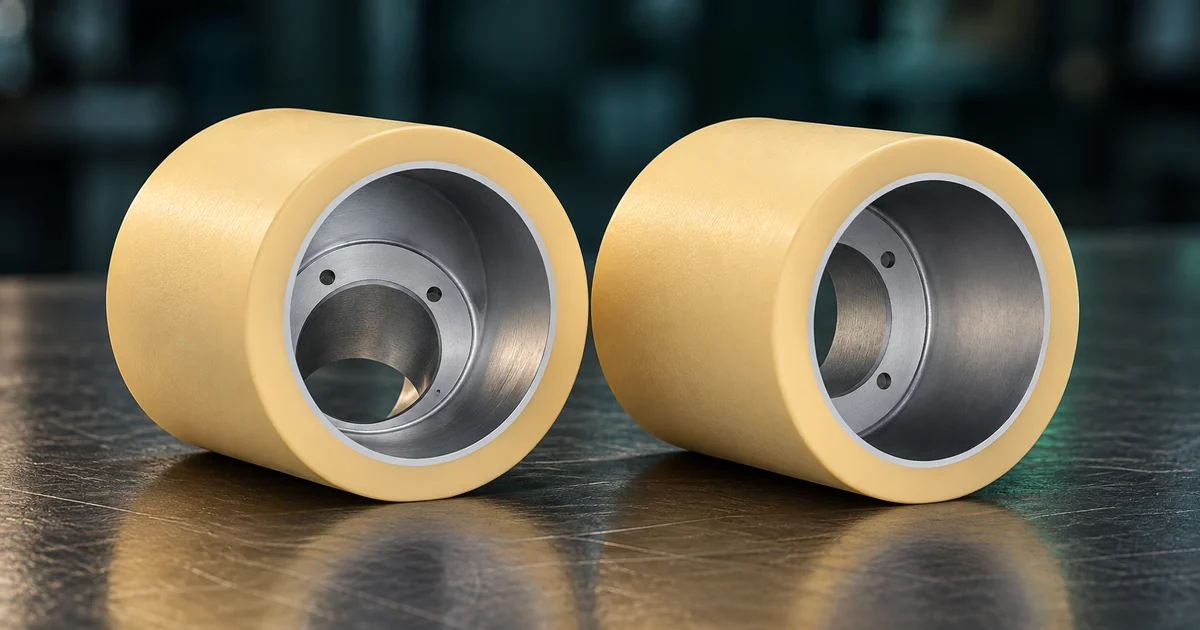
Choosing the right rubber roll for rice milling is not a one-size-fits-all decision. Basmati paddy requires a completely different roll specification than IR64 or Sona Masuri - and using the wrong hardness is one of the most common hidden causes of high broken rice percentage. This guide explains how to choose the correct rice rubber rolls for Basmati and non-Basmati varieties, when to replace them, and what signs indicate the wrong spec - from Gold Mohur Overseas, ISO-certified rubber roller manufacturer since 1985.
Why Rubber Roll Selection Differs Between Basmati and Non-Basmati
The physical difference between Basmati and non-Basmati paddy grains determines the correct roll specification:
| Property | Basmati Paddy | Non-Basmati (IR, Sona Masuri, Parmal) |
|---|---|---|
| Grain length | 6.5-8.5mm (long) | 4.5-6.5mm (medium/short) |
| Grain width | 1.5-2.0mm (slender) | 2.0-3.0mm (wider) |
| Grain L/W ratio | >3.5 (very slender) | 2.0-3.0 (medium) |
| Grain fragility | High - breaks easily under lateral force | Medium - more tolerant of roller pressure |
| Husk thickness | Thin, loose-fitting | Medium, tighter fit |
| Optimal roll hardness | 55-60 Shore A (soft) | 60-67 Shore A (medium) |
📌 The slender L/W ratio of Basmati grain means lateral force from the roller acts on a much smaller cross-section. A harder roll exerts more force per unit area - which is fine for a short, round IR grain but shatters the thin waist of a Basmati grain. This is why Basmati mills running standard-hardness rolls see 5-10% more broken rice than mills using correctly spec’d soft rolls.
Complete Rubber Roll Hardness Guide by Paddy Variety
| Paddy Variety | Roll Hardness (Shore A) | State / Region | Notes |
|---|---|---|---|
| Basmati (1121, Pusa, Taraori) | 55-60 | Punjab, Haryana, UP, Uttarakhand | Soft roll critical. Never exceed 62 Shore A on Basmati. |
| Sharbati (MP Basmati-type) | 58-62 | Madhya Pradesh | Slightly shorter than Basmati - medium-soft |
| IR64 / IR36 | 62-65 | Andhra Pradesh, Odisha, West Bengal | Standard commercial medium-grain |
| Sona Masuri (BPT5204) | 60-64 | Andhra Pradesh, Telangana, Karnataka | Premium medium-grain - slightly softer spec than IR64 |
| Parmal (PR106, PR114) | 62-66 | Punjab, Haryana | Short-grain, hard husk - standard hardness |
| Swarna (MTU7029) | 62-65 | West Bengal, Odisha, Bihar | High-yielding, medium-grain |
| Parboiled paddy (any variety) | 65-72 | All regions | Parboiling hardens grain - always use harder roll than raw equivalent |
| HMT / Jeera Samba | 60-64 | Tamil Nadu, Kerala | Fragrant short-grain - handle gently |
How to Identify the Wrong Rubber Roll Specification
If your mill is using the wrong roll hardness, the symptoms appear in the output - not on the machine:
| Symptom | Likely Cause | Diagnosis |
|---|---|---|
| High broken rice despite correct moisture | Roll too hard for paddy type | Test with 1-2 Shore A softer roll pair |
| Rolls wearing very fast (<200T) | Roll too soft for hard-husked paddy | Switch to 3-5 Shore A harder roll |
| Low husking efficiency (<80%) | Roll too soft (slipping on hard husk) OR gap too wide | Check gap setting first; if correct, harden roll spec |
| Grain surface scratches / bruising | Roll too hard, surface damage not breakage | Reduce hardness; check for stone contamination in paddy |
| Good efficiency but rolls wearing unevenly | Mismatched pair (different hardness or wear stage) | Always replace both rolls simultaneously from same batch |
When to Replace Rice Rubber Rolls
Most millers replace rolls reactively - when husking efficiency collapses. Proactive replacement based on these indicators gives you planned downtime instead of emergency stops:
- Diameter reduction: Replace when either roll has reduced by 15-20mm from original diameter
- Diameter mismatch: Replace both rolls when the fast and slow roll differ by more than 8mm
- Surface condition: Replace when surface shows glazing (smooth, shiny - grip lost) or cracks deeper than 2mm
- Husking efficiency: Replace when efficiency drops below 80% with correct gap setting - gap adjustment no longer compensates
- Throughput milestone: Track tonnes processed since last replacement - replace proactively at 80% of expected lifespan for your paddy type
🆕 Always replace rubber rolls in pairs - both rolls at the same time. A new roll running against a worn roll creates uneven grip, shock-loads the new roll, and increases broken rice. The cost saving of “using the worn roll a little longer” is always exceeded by the extra breakage and accelerated new-roll wear. Both rolls or neither.
Rubber Roll Installation & Break-In
New rolls need a short break-in period before operating at full efficiency:
- First 2-4 hours: Run at 70-80% of normal paddy feed rate - allows roll surface to conform and temperature to stabilise
- Gap setting: New rolls are at maximum diameter - start with a slightly wider gap than usual and tighten as needed based on husking efficiency
- Temperature check: Roll surface should warm to 30-40°C during operation - excessive heat (above 55°C) indicates too-tight gap or under-lubricated paddy
- Husking efficiency target: Should reach 88-92% within the first shift on correctly spec’d rolls with optimal paddy moisture
- First inspection: Check roll surface after 20-30 tonnes - uneven wear in first run indicates gap misalignment
Key Indicators: When Your Roll Needs Replacing
FAQ: Rice Rubber Rolls for Basmati and Non-Basmati
What rubber roll hardness is best for Basmati rice?
For Basmati paddy, use soft rubber rolls with 55-60 Shore A hardness. Basmati’s long, slender grains are highly breakage-prone under excess roller pressure. Using 65+ Shore A rolls on Basmati increases broken rice by 5-10 percentage points compared to correctly spec’d soft rolls.
What is the difference between rubber rolls for Basmati and non-Basmati rice?
Basmati rolls: softer (55-60 Shore A) to protect the long grain. Non-Basmati IR/Parmal/Sona Masuri: medium-hard (60-67 Shore A). Parboiled non-Basmati: harder (65-72 Shore A) due to hardened grain structure. The softer the roll, the gentler the grip - essential for slender, fragile long grains.
How often should rubber rolls be replaced in a rice mill?
Replace when: (1) husking efficiency drops below 80% with correct gap; (2) diameter difference between rolls exceeds 8mm; (3) surface shows glazing or cracks >2mm deep. Throughput lifespan: 300-800 tonnes depending on paddy hardness and moisture. Always replace in pairs.
What happens if I use the wrong hardness rubber roll for my paddy?
Too soft for hard paddy: 2-3x faster roll wear. Too hard for long-grain paddy: 3-8% extra broken rice - significant revenue loss. Correct hardness is as important as roll quality. Specify your paddy variety and moisture when ordering.
Can I use the same rubber rolls for both Basmati and non-Basmati paddy?
No. Running Basmati through IR-spec rolls (62-65 Shore A) increases broken rice by 4-8 points. If your mill processes both, maintain two sets and swap when changing paddy type. The cost of a spare set of Basmati rolls is far less than one season of excess breakage.
Order Rubber Rolls Matched to Your Paddy Variety
Gold Mohur Overseas supplies rubber rolls in every hardness grade - from 55 Shore A for Basmati to 72 Shore A for parboiled hard paddy. Specify your variety and moisture. ISO-certified since 1985.