

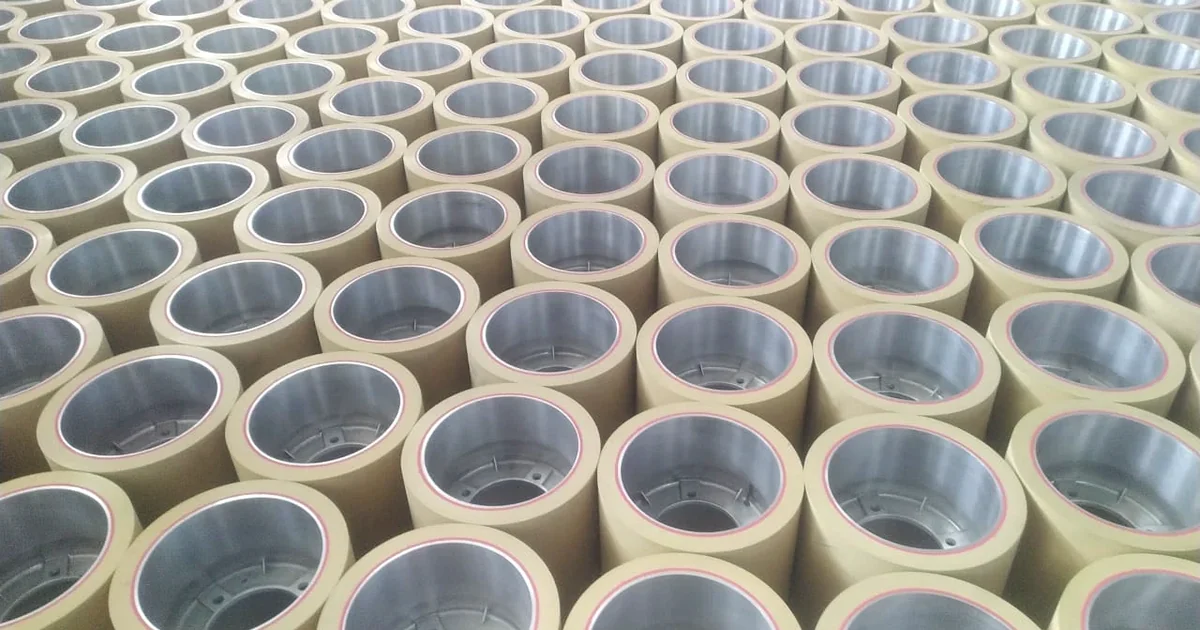
A rice rubber roller looks simple - a cylinder of rubber on a metal core. But the manufacturing process behind it determines whether your husker runs at 90% efficiency or 75%, whether your head rice recovery meets spec, and whether the roll lasts 80 tonnes or 50 tonnes before replacement. This guide covers how rice rubber rollers are manufactured step by step - from compound formulation to final quality testing. From Gold Mohur Overseas, manufacturing rice rubber rollers in India since 1985.
Step 1: Raw Material Selection and Compound Formulation
The rubber compound is the foundation of roller performance. Two base materials are used in Indian rice mill roller manufacturing:
| Compound | Properties | Best For |
|---|---|---|
| Natural rubber (NR) | High resilience, excellent grip, low heat build-up | Basmati, long-grain, fragile varieties |
| Nitrile rubber (NBR) | Oil/heat resistant, better abrasion life, harder | Parboiled rice, high-throughput continuous mills |
| NR-NBR blend | Balanced properties, versatile | General-purpose, mixed paddy types |
Compounding adds: sulphur (vulcanising agent), accelerators (control cure rate), carbon black or silica (reinforcement for abrasion resistance), plasticisers (control flexibility), and antioxidants (extend shelf life). The compound recipe directly controls the final Shore A hardness of the roll.
Step 2: Mixing and Sheeting
Raw rubber and additives are mixed in an internal mixer (Banbury mixer) at controlled temperature and time. Incomplete mixing creates hardness variation within a batch - which is why ISO-certified manufacturers specify mixing time and temperature precisely.
Open Mill Sheeting
After internal mixing, the compound passes through open two-roll mills to produce uniform sheets. Sheet thickness is measured at multiple points to ensure homogeneity before the next stage. Any sheet showing hardness deviation beyond ±2 Shore A is rejected.
Step 3: Metal Core Preparation
The metal shaft (core) that the rubber bonds to must be prepared correctly for the bond to hold under husking loads:
- Steel selection: mild steel or EN8 grade depending on husker shaft load rating
- Machining: turned to specified diameter with surface roughness Ra 3.2-6.3 μm for bonding
- Shot blasting: removes mill scale and creates anchor profile for adhesive
- Priming: rubber-to-metal bonding agent (typically phenolic-based) applied and dried
- Final cleaning: solvent wipe before rubber application
Bond failure between rubber and core is the most common cause of premature roller failure in the field. Under-preparation of the metal surface is the root cause in most cases.
Step 4: Building (Rubber Application)
The compounded rubber sheets are cut and wrapped around the prepared metal core in layers, building up to the specified diameter. For a standard 300mm outer diameter roller, multiple layers are applied:
- Each layer is hand-pressed or rolled to eliminate trapped air (air bubbles = weak spots)
- Layer direction alternates to prevent preferential cracking
- Total rubber thickness: typically 15-30mm depending on roll specification
- Diameter is built slightly oversize to allow for vulcanisation shrinkage and final grinding
Step 5: Vulcanisation
Vulcanisation is the heat-and-pressure curing process that cross-links the rubber polymer chains, converting the soft compound into elastic, resilient rubber with the target Shore A hardness.
Vulcanisation Parameters
| Parameter | Typical Range | Effect of Deviation |
|---|---|---|
| Temperature | 140-160°C | Too low = under-cure (soft, high wear); Too high = over-cure (hard, brittle) |
| Pressure | 5-15 bar | Low pressure = voids and delamination |
| Time | 30-90 minutes | Under-time = soft centre; Over-time = over-hardened surface |
Vulcanisation is performed in steam autoclaves or hydraulic press moulds. Autoclave curing produces more uniform temperature throughout the rubber mass - critical for thick rollers where temperature gradients cause hardness variation between surface and core.
Step 6: Grinding to Final Dimensions
After vulcanisation, the roller is ground on a centreless or cylindrical grinder to achieve:
- Final outer diameter within ±0.3mm of specification
- Concentricity (runout): below 0.1mm TIR for quality-grade rolls
- Surface finish: Ra 1.6-3.2 μm - smooth enough for consistent grain contact, rough enough to maintain grip
- Width to ±0.5mm of specification
Grinding generates heat - coolant flood is used to prevent surface hardening. Any roll showing concentricity above 0.15mm is rejected at this stage.
Step 7: Quality Testing and Inspection
ISO-certified nitrile rubber rice dehusking roll manufacturers test every roll before dispatch:
- Shore A hardness: measured at 6 points (3 along length, 2 around circumference each) - all points must be within ±2 Shore A of specification
- Dimensional check: diameter, width, bore diameter, concentricity
- Visual inspection: surface cracks, exposed metal, voids, delamination
- Dynamic balance: spin test to verify mass balance - critical for high-speed huskers
- Bond test: sample rolls per batch tested for rubber-to-metal peel strength
📌 Gold Mohur Overseas has manufactured rice rubber rollers since 1985. Every batch includes Shore A certification, dimensional report, and is supplied as matched pairs from the same production run. Ask for the test certificate with your order.
FAQ: Rice Rubber Roller Manufacturing
What rubber compound is used in rice dehusking rolls?
Natural rubber (NR) for fragile varieties like basmati, nitrile rubber (NBR) for parboiled and high-throughput mills, or NR-NBR blends as a general-purpose option. Compound selection affects hardness, abrasion life, and heat resistance.
What hardness is used for rice rubber rollers?
55-60 Shore A for fragile basmati and long-grain; 60-65 Shore A for standard sona masuri; 65-75 Shore A for parboiled rice. Hardness is set during vulcanisation by controlling temperature, time, and sulphur content.
How are rice rubber rollers quality tested?
Shore A hardness at 6 points; dimensional check (diameter, width, concentricity); visual inspection for surface defects; dynamic balance test; and rubber-to-metal bond peel strength test on batch samples.
What is the difference between natural rubber and nitrile rubber rice rolls?
Natural rubber: higher resilience, better grip, lower heat - preferred for basmati. Nitrile: heat and oil resistant, better abrasion life - preferred for parboiled. NR-NBR blends balance both.
What does vulcanisation do to rubber rollers?
Vulcanisation cross-links rubber polymer chains via heat and sulphur, converting soft compound into elastic, load-bearing rubber with target Shore A hardness. Under-cure = soft and fast-wearing; over-cure = hard and brittle.
Rice Rubber Rollers - ISO-Certified, Matched Pairs
Gold Mohur Overseas supplies Shore A certified, dimensionally matched roller pairs with full test documentation. Customised to your husker make, model, and paddy variety since 1985.