

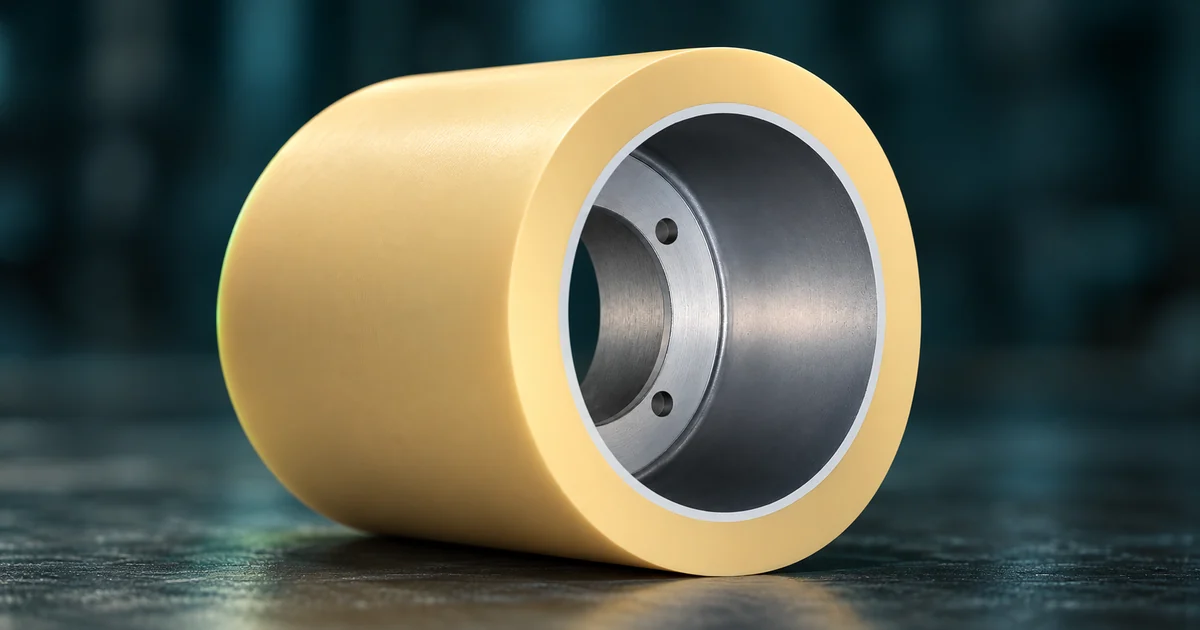
Choosing between a rubber roller husker and a steel huller is one of the first and most consequential decisions in setting up a rice mill. The wrong choice costs you 10-20% of your head rice every single day. This complete comparison of rubber roller vs steel huller covers working principle, head rice recovery, breakage, running costs, paddy compatibility, and which to buy - from Gold Mohur Overseas, India’s rubber roller manufacturer since 1985.
How Each Machine Works
🪄 Rubber Roller Husker (Rubber Roll Huller)
- Two counter-rotating rubber rollers at slightly different speeds
- Speed differential creates friction that peels husk off the grain
- Grain is squeezed and rolled - not impacted or abraded
- Husk is removed in one clean strip - bran layer stays intact
- Aspiration separates husk from brown rice output
- Un-husked grains return for a second pass (paddy separator)
- Key wear part: the rubber rollers (replaceable every 300-800T)
⚙️ Steel Huller (Engelberg-Type)
- Steel rotor with projecting pins/blades inside a steel drum
- Paddy is impacted, abraded, and forced through a screen
- Removes husk AND partially removes bran in one pass
- High-impact process - grains are stressed and often cracked
- Output is white(ish) rice directly - no separate whitener needed
- No consumable rollers - steel lasts longer before replacement
- Cannot adjust husking intensity independently of whitening
Head Rice Recovery: The Critical Difference
Head rice recovery (whole grain %) is the primary quality metric in rice milling. It directly determines your revenue per tonne of paddy. The difference between rubber roller and steel huller on this metric alone justifies the comparison:
| Metric | Rubber Roller Husker | Steel Huller |
|---|---|---|
| Head rice recovery | 60-68% | 48-58% |
| Broken rice % | 3-8% | 15-30% |
| Husking efficiency | 85-95% | 70-85% |
| Bran layer removal | Husking only (bran intact) | Partial bran removal (combined) |
| Rice whiteness degree | Controlled (separate whitener) | Inconsistent (single-pass) |
| Chalky grain handling | Good - gentle action | Poor - chalky grains shatter |
| Parboiled paddy | Excellent - hard grain handled well | Acceptable |
| Long-grain (Basmati) | Excellent - gentle action preserves length | Poor - high breakage on long grains |
📈 Revenue impact on 1 TPH mill: At 65% head rice recovery (rubber roller) vs 55% (steel huller), processing 400T paddy/month: rubber roller yields 260T whole rice vs 220T. At a ₹2,000-2,200/qtl price difference (whole vs broken), rubber roller earns roughly ₹8,00,000-8,80,000 more per month on the same paddy input. This gap covers the cost of rubber rollers many times over.
Running Costs: Rubber Roller vs Steel Huller
| Cost Factor | Rubber Roller Husker | Steel Huller |
|---|---|---|
| Machine purchase price | ₹80,000-3,00,000 | ₹15,000-80,000 |
| Wear part cost | Rubber rollers: ₹800-2,500/pair per 400-600T | Steel drum/screen: ₹2,000-8,000, lasts longer |
| Power consumption (1 TPH) | 5-10 HP | 10-20 HP (higher due to impact mechanism) |
| Operator skill required | Medium - roller gap setting needs training | Low - simple adjustment |
| Maintenance frequency | Roller replacement every 300-800T | Steel parts last longer; more downtime when they fail |
| Total cost of ownership (5 years) | Lower (head rice revenue offset) | Higher (lower revenue despite lower initial cost) |
Which Paddy Varieties Work Best with Each Machine?
✅ Rubber Roller: Best For
- Basmati (long grain) - gentle action preserves grain length
- IR varieties (IR64, IR36, IR8) - standard commercial milling
- Sona Masuri - medium grain, quality-sensitive
- Parmal & PR varieties - Punjab/Haryana commercial paddy
- Parboiled paddy - harder grain, rollers handle well
- Export-grade paddy - head rice recovery matters for export pricing
- Any paddy where final price per kg depends on grade
⚠️ Steel Huller: Limited To
- Small rural village mills with no quality requirements
- Home/household processing (very low volume)
- Situations where capital cost is the only constraint
- Paddy destined for local consumption only (not retail/export)
- Short-grain coarse varieties with thick husks
- Not recommended for Basmati, Sona Masuri, or any export-grade paddy
- Not suitable for any commercial mill above 0.3 TPH
Rubber Roller Selection: Hardness Matters as Much as the Machine
With a rubber roller husker, the machine quality matters - but the rubber roller hardness selection is equally critical. The wrong hardness for your paddy type increases breakage even on a good machine:
| Paddy Type | Recommended Hardness (Shore A) | Reason |
|---|---|---|
| Basmati (long grain) | 55-60 | Soft roller - gentle grip prevents breakage on slender grains |
| IR varieties (IR64, IR36) | 60-65 | Standard hardness for medium-grain commercial paddy |
| Sona Masuri | 60-65 | Medium grain, similar to IR varieties |
| Parmal / PR varieties | 62-67 | Slightly harder husk in Punjab/Haryana varieties |
| Parboiled paddy | 65-70 | Harder grain post-parboiling needs firmer grip |
| High-silica / tropical varieties | 65-72 | Thick, abrasive husks need harder roller to avoid slip |
🆕 Always specify your paddy variety and average moisture content when ordering rubber rollers. A roller that is 10 Shore A too hard for your paddy increases broken rice by 3-5 points. A roller that is too soft wears rapidly on hard-husked varieties. Contact Gold Mohur Overseas - we have supplied rollers for every major Indian paddy variety since 1985 and will recommend the correct hardness for your specific situation.
Rubber Roller vs Steel Huller: Final Verdict
| Factor | Rubber Roller Wins? | Notes |
|---|---|---|
| Head rice recovery | ✅ Yes | 5-10% higher recovery = direct revenue advantage |
| Broken rice % | ✅ Yes | 3-8% vs 15-30% - dramatic difference |
| Output grain quality | ✅ Yes | Separate whitening gives controlled polish level |
| Basmati / long-grain suitability | ✅ Yes | Steel huller not suitable for Basmati at all |
| Initial machine cost | ❌ No | Steel huller is cheaper upfront |
| Simplicity of operation | ❌ No | Steel huller simpler - but less controllable |
| Total cost of ownership (5yr) | ✅ Yes | Higher revenue makes rubber roller cheaper overall |
| Regulatory / export compliance | ✅ Yes | Export buyers require rubber roller milling for grade |
📌 Bottom line: For any commercial rice mill - mini, small, or large - the rubber roller husker is the correct choice. The steel huller’s lower purchase price is entirely offset within the first month of operation by higher head rice recovery. The steel huller only makes sense for household or very low-volume village milling where grain grade does not affect price.
FAQ: Rubber Roller vs Steel Huller
What is the difference between a rubber roller husker and a steel huller?
A rubber roller husker uses two counter-rotating rubber rollers to remove husk by friction - gentle, producing 3-8% broken rice. A steel huller uses a metal rotor to abrade and impact the husk off - faster to set up but produces 15-30% broken rice. Rubber roller is the global commercial standard.
Which is better: rubber roller or steel huller?
Rubber roller huskers are better for all commercial milling. They deliver 5-10 percentage points higher head rice recovery and 3-8% broken rice vs 15-30% for steel hullers. Steel hullers are only used where initial capital cost is the only constraint - village or household scale only.
What is a rubber roll huller?
A rubber roll huller (rubber roller husker) removes paddy husk using two counter-rotating rubber rollers at different speeds. The speed differential creates friction that cleanly pops the husk off without shattering the grain. Rubber rollers are the key wear part - replaceable every 300-800 tonnes of paddy throughput.
How long do rubber rollers last in a rice huller?
Rubber rollers in a rice huller last 300-800 tonnes of paddy throughput (20-60 working days at 1 TPH). Harder, drier paddy wears them faster. Correct hardness selection extends life by 20-40%. Always replace in pairs - mismatched rollers increase breakage.
What paddy varieties work best with rubber roller huskers?
Rubber roller huskers work with all paddy varieties: Basmati (soft rollers, 55-60 Shore A), IR varieties (60-65), Sona Masuri (60-65), Parmal/PR varieties (62-67), parboiled paddy (65-70). Steel hullers are not suitable for Basmati or any export-grade paddy.
Get the Right Rubber Rollers for Your Husker
Gold Mohur Overseas supplies ISO-certified rubber rollers matched to your husker model, paddy variety, and moisture range. Trusted by rice mills across India and 40+ countries since 1985.