

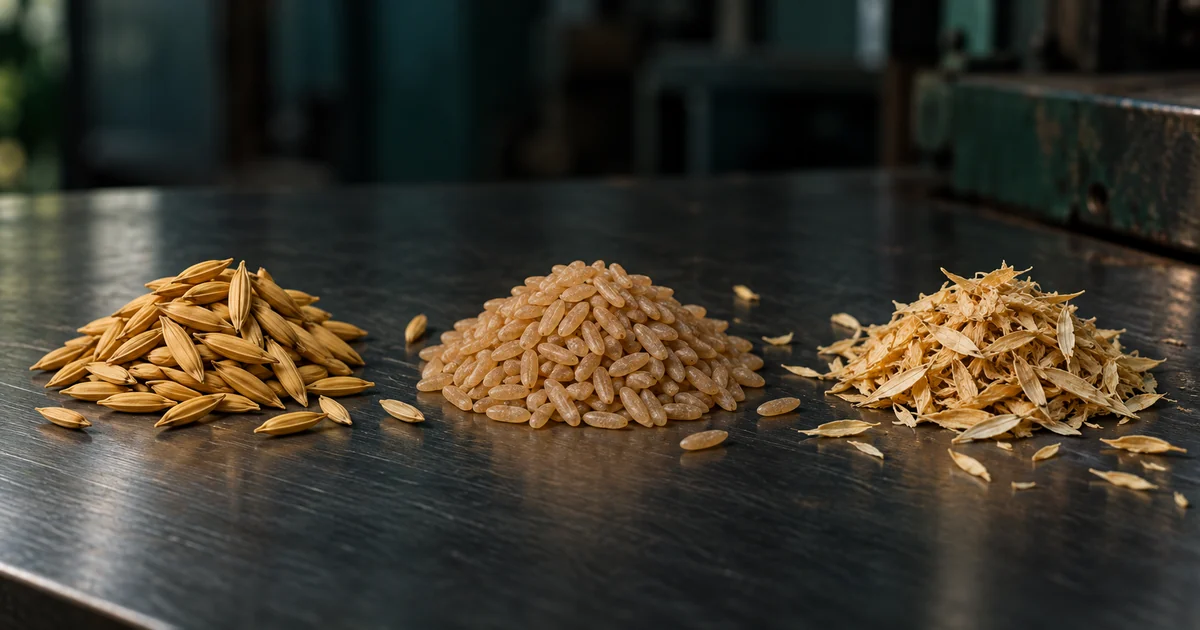
Every tonne of paddy that passes through a rice mill starts at the same place: the husker. The dehusking stage determines the grain’s condition for every process that follows - whitening, polishing, grading. When dehusking is consistent, head rice recovery is predictable, breakage is low, and the mill runs efficiently. When it is inconsistent, broken grain accumulates at the whitener, recovery drops, and recirculation builds up throughput-limiting loops. This guide covers what consistent dehusking of rice actually means, what breaks it, and how to fix it. From Gold Mohur Overseas, India’s rubber roller manufacturer since 1985.
What Is Dehusking and What Makes It Consistent?
Dehusking (dehulling) removes the outer husk from paddy grain by passing it between two rubber rolls spinning at slightly different speeds. The friction strips the husk while leaving the bran layer intact.
Consistent dehusking means achieving the same husking efficiency across every batch, every shift, every day. In numbers:
| Metric | Consistent (Target) | Inconsistent (Problem) |
|---|---|---|
| Husking efficiency per pass | 85-95% | Below 80% or varying 70-90% |
| Paddy recirculation rate | Below 8% | Above 15% (energy + throughput loss) |
| Broken rice at whitener input | 2-4% | Above 6% (yield loss) |
| Head rice recovery | 68-72% (varies by variety) | Below 65% consistently |
The 5 Causes of Inconsistent Dehusking
1. Worn Rubber Rolls
The most common cause. As rubber wears, the roll surface loses its grip profile and the gap geometry changes. A worn roll cannot grip grain cleanly - some pass through unhusked, others are gripped too hard and crack. Monitor roll diameter monthly and replace as matched pairs every 60-80 tonnes (basmati) or 80-120 tonnes (parboiled).
2. Incorrect Gap Setting
The gap between rolls must be set for the specific paddy variety and moisture level. Too wide: paddy passes through unhusked (low efficiency). Too narrow: grain is crushed (high breakage). Standard gap setting: 0.1-0.3mm less than paddy grain thickness, measured at the narrowest point of the nip.
3. Wrong Paddy Moisture
Paddy moisture at 13-14% is optimal. Below 12%: grain is brittle - high breakage even with correct gap. Above 15%: husk adheres more tightly - husking efficiency drops, recirculation rises. Batch-to-batch moisture variation is the hidden driver of husking inconsistency that operators often attribute to roller wear.
4. Imbalanced Roll Pair
Mismatched roll diameter or hardness creates uneven gap pressure across the roll width. One side over-husks; the other under-husks. A roll diameter difference of 2mm across a pair causes significant pressure variation. Always replace rolls as matched pairs from the same batch.
5. Uneven Paddy Feed Distribution
Paddy feeding concentrated in one lane across the roll width causes localised roll wear on that lane, while the rest of the roll sees less load. Within 20-30 tonnes, the roll develops a wear profile that creates inconsistent gap - even with a correct average gap setting. Check feed gate alignment and ensure uniform paddy distribution across the full roll width.
Financial Impact of Inconsistent Dehusking
| Problem | Direct Cost (1 TPH mill) |
|---|---|
| 2% extra breakage at whitener | ₹1,04,000-1,14,000/month (broken rice price vs head rice price) |
| 10% recirculation (vs 5% baseline) | ₹8,000-15,000/month (extra energy + throughput cap) |
| 1% lower head rice recovery | ₹52,000-57,000/month |
| Emergency roller replacement (wrong timing) | ₹5,000-12,000 + 4-8 hrs downtime |
How to Achieve Consistent Dehusking: Checklist
- Check paddy moisture before each lot. Adjust gap if moisture deviates more than 1% from previous batch.
- Set roller gap for each paddy variety. Basmati requires a wider gap than parboiled. Use feeler gauges, not estimation.
- Inspect roll surface visually every week. Look for flat spots, glazing, or uneven wear patterns.
- Measure roll diameter monthly. Use calipers at three points along the width. Log results.
- Replace rolls as matched pairs before either drops below 95% of original diameter.
- Check feed gate alignment every time rolls are replaced - correct distribution resets roll wear pattern.
- Monitor recirculation rate per shift. If above 12%, investigate gap, moisture, or roll condition before assuming it’s a paddy quality issue.
📌 The single highest-impact action: Replace rubber rolls on schedule, as matched pairs. Mills that track tonnage per pair and replace proactively consistently outperform mills that replace on feel or on visible failure. The 2-3% head rice recovery difference between a well-maintained husker and a neglected one compounds over every shift.
FAQ: Consistent Dehusking of Rice
What is dehusking of rice?
Dehusking removes the outer husk from paddy grain to produce brown rice, performed by passing paddy between two rubber rolls at slightly different speeds. Consistent dehusking = 85-95% husking efficiency per pass with minimum grain breakage.
What is a good dehusking efficiency rate?
85-95% per pass with quality rubber rolls and correct gap setting. Below 80% indicates worn rollers, incorrect gap, or paddy moisture outside the 13-14% range.
What causes inconsistent dehusking?
(1) Worn rubber rolls; (2) Incorrect gap setting; (3) Wrong paddy moisture; (4) Imbalanced roll pair; (5) Uneven paddy feed. Most mills have 2-3 of these operating simultaneously.
How does dehusking affect head rice recovery?
A 2% improvement in husking efficiency translates to 1-2% higher head rice recovery - worth ₹52,000-1,14,000/month on a 1 TPH mill. Inconsistent dehusking creates cracked grain that breaks during whitening, permanently reducing head rice yield.
How often should rubber rolls be replaced for consistent dehusking?
Every 60-80 tonnes for basmati, 80-120 tonnes for parboiled. Always as matched pairs. Replace when either roll drops below 95% of original diameter or the pair shows more than 2mm diameter differential.
Rubber Rolls That Hold Their Gap Longer
Gold Mohur Overseas manufactures matched-pair rubber rolls with Shore A certification - designed for consistent husking efficiency across the full replacement interval. Specify your paddy variety and husker model when ordering.