

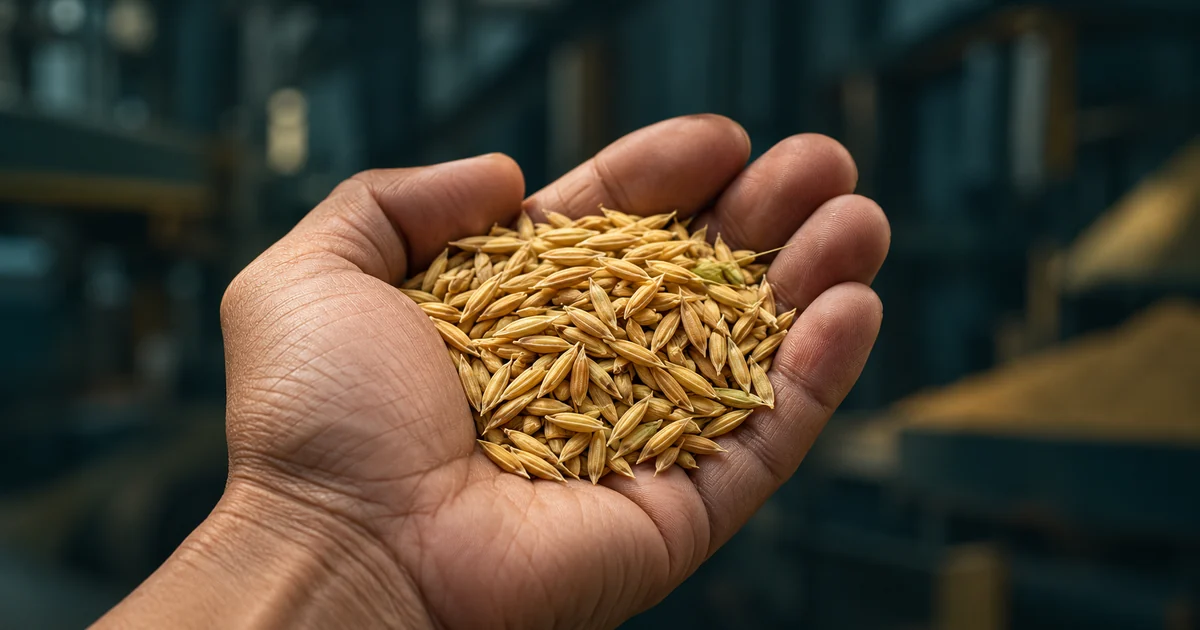
Moisture content in paddy is not just a storage concern - it is the single biggest factor that determines broken rice percentage at the dehusking stage. Mills that ignore paddy moisture before running it through rubber roller huskers face markedly higher breakage, premature roller wear, and poor output quality. This guide explains the science of paddy moisture content, the correct range for dehusking, and how moisture control directly protects your rubber rollers and mill profitability - from Gold Mohur Overseas, India’s rubber roller manufacturer since 1985.
What Is Dehusking? (Dehusking Meaning)
Dehusking (also called husking or hulling) is the mechanical process of removing the outer husk from harvested paddy grains to produce brown rice. The husk is the hard, inedible, silicon-rich outer shell that protects the grain during growth. Raw rice husk is roughly 15-28% silica by weight, which is what makes the stripped husk abrasive to rubber during husking (ScienceDirect review). It must be removed before the rice can be milled, whitened, or consumed.
The dehusking process in a modern rice mill uses a rubber roller husker - two counter-rotating rubber rollers that apply friction to the paddy grain, stripping the husk cleanly. The gap between the rollers, the roller speed differential, and the paddy moisture content at the time of husking all determine husking efficiency and the percentage of broken grains.
📌 Dehusking vs Milling: Dehusking removes only the outer husk → produces brown rice. Milling is the complete process: dehusking + whitening (removing bran) + polishing → produces white rice. Moisture control at the dehusking stage affects every downstream step.
Why Moisture Content Controls Everything in Dehusking
The rubber roller husker works by gripping the paddy grain between two rollers and applying differential friction to pop the husk off. This works cleanly only within a specific moisture window. Outside that window, the physics change - and the consequences show immediately in output quality.
✕ Too Wet (>18% moisture)
- Husks are flexible - rollers can’t grip cleanly
- Husking efficiency drops sharply
- Rubber rollers wear significantly faster (Gold Mohur Overseas field data)
- Rice surface stays sticky - poor whitening
- Mold risk if stored after milling
- Energy consumption rises
✕ Too Dry (<11% moisture)
- Grains are brittle - crack under roller pressure
- Broken rice rises and head-rice recovery falls
- Head rice recovery drops significantly
- Grains shatter during whitening and polishing
- Roller gap adjustments don’t fix the problem
- Lost revenue: broken grain sells for roughly half the value of head rice
Ideal Paddy Moisture Content for Dehusking
The universally accepted ideal moisture content of rice paddy for milling is 13-14% (wet basis). This narrow range balances husk flexibility (easy to strip) with grain rigidity (won’t shatter under roller pressure).
Independent guidance from the IRRI Rice Knowledge Bank confirms 14% moisture as the optimum for milling: milling paddy that is too dry lets the kernels adsorb moisture and fissure (crack), which raises breakage and lowers head-rice recovery.
| Moisture % | Condition | Effect on Dehusking | Recommended Action |
|---|---|---|---|
| <11% | Over-dried | High breakage, lower head-rice recovery | Tempering: add controlled humidity before milling |
| 11-13% | Slightly dry | Mild breakage risk, acceptable with roller gap adjustment | Proceed with wider roller gap setting |
| 13-14% | Optimal | Maximum husking efficiency, minimum breakage | Mill immediately |
| 14-18% | Slightly wet | Reduced husking efficiency, faster roller wear | Sun-dry or machine-dry 1-2 days first |
| >18% | Freshly harvested | Poor husking, very high roller wear, mold risk | Must dry before milling - do not attempt dehusking |
How Dehusking Using Air Currents Works
A term that frequently appears in rice processing literature - “dehusk grain using air currents” - refers to the paddy separator / aspiration system, not the primary husking mechanism. Here’s how it fits into the milling sequence:
- Step 1 - Rubber roller husking: The paddy passes through two rubber rollers at a speed differential. Friction strips the husk from most grains (85-92% efficiency at optimal moisture).
- Step 2 - Air current separation (aspiration): The husked output - a mix of brown rice, un-husked paddy, and loose husk - passes through an aspiration channel. A controlled airflow (air current) carries the lightweight husk and chaff upward and out, while heavier brown rice and paddy fall through.
- Step 3 - Paddy separator: A gravity or vibration-based paddy separator further isolates un-husked paddy grains and returns them to the husker for a second pass.
📌 The air current does not remove the husk from the grain - the rubber roller does that. The air current removes the already-stripped husk from the grain stream. Both steps depend on correct paddy moisture: wet paddy produces soggy husk that clogs aspiration channels and reduces air separation efficiency.
How Moisture Affects Rubber Roller Life
The rubber roller is the highest-wear component in a dehusking unit. Its wear rate is directly tied to paddy moisture and paddy abrasiveness. Moisture affects rollers in two opposing ways:
📈 Wet Paddy: Mechanical Wear
- Wet paddy grains slide rather than grip
- Rollers must work harder to strip husk
- Increased slip = increased surface abrasion
- Roller diameter reduces faster
- Roller gap needs constant readjustment
- Lifespan: 40-60% shorter on wet paddy (Gold Mohur Overseas field data)
📈 Dry Paddy: Chemical Wear
- Dry paddy husk is more abrasive (higher silica)
- Micro-cuts on rubber surface accumulate
- Roller surface hardens and loses grip over time
- Husking efficiency drops before diameter does
- Hardness mismatch: dry paddy needs softer rollers
- Lifespan: shorter on consistently over-dried paddy
🆕 Roller selection tip: Paddy at 13-14% moisture in typical rice-growing regions (IR varieties, Basmati, Parmal) works best with medium-hard rubber rollers (60-65 Shore A). For Sona Masuri or high-silica varieties, slightly harder (65-70 Shore A). Always specify your paddy variety and average moisture when ordering rubber rollers - hardness matters as much as diameter.
How to Measure Paddy Moisture Before Milling
Accurate moisture measurement is the first step in controlled dehusking. Here are the methods used in Indian rice mills:
| Method | Accuracy | Speed | Best For |
|---|---|---|---|
| Digital moisture meter | ±0.5% | 30 seconds | Daily mill operations - most practical |
| Oven drying method | ±0.1% | 24-48 hours | Lab calibration, accuracy verification |
| Capacitance-based probe | ±1% | 10 seconds | Bulk paddy storage monitoring |
| NMR moisture analyser | ±0.05% | 2 minutes | Export-grade quality labs |
📌 Practical protocol: Test 3 samples from different positions in the paddy lot (top, middle, bottom of storage bag/pile). Average the three readings. If any reading exceeds 16%, dry the entire lot before milling. Do not average-out a high reading - the wettest grains set the breakage rate.
Paddy Drying Methods to Achieve Correct Moisture
If paddy arrives above 18% moisture (freshly harvested), it must be dried before dehusking. Common methods:
| Drying Method | Time to 14% | Cost | Risk |
|---|---|---|---|
| Sun drying (spread on tarpaulin) | 2-4 days (weather dependent) | Near zero | Rain risk, uneven drying |
| Mechanical flat-bed dryer | 6-12 hours | ₹80-150/tonne | Over-drying if unmonitored |
| Recirculating batch dryer | 4-8 hours | ₹120-200/tonne | Low - temperature-controlled |
| LSU continuous dryer | 2-4 hours | ₹150-250/tonne | Capital-intensive, best quality |
Moisture Control: Impact on Milling Profitability
As an illustrative example (at typical Indian market prices), a 1% reduction in broken rice percentage on a 1 TPH mill (16 hrs/day, 25 days/month) processing 400 tonnes of paddy translates directly to revenue. At 65% milling yield, 400T paddy = 260T rice. A 1% improvement in head rice recovery = 2.6 extra tonnes of whole rice per month; at a whole-vs-broken price uplift of roughly ₹2,000-2,200/qtl, that is about ₹52,000-57,000 in additional monthly value. This is the monetary value of one moisture meter reading. Broken grain fetches only about half the market value of head rice (IRRI Rice Knowledge Bank), so every percentage point of breakage is direct lost revenue.
💲 ROI calculation: A quality digital moisture meter costs ₹3,000-8,000. At the savings above, it pays for itself within the first week of correct use. Moisture control is not an overhead - it is a profit lever.
How Is Rice Husking Efficiency Measured?
Husking efficiency is the share of paddy whose husk is removed in a single pass. On a correctly set rubber-roll husker, about 90% of the paddy should be husked on the first pass, with unhusked grain kept under 10% - this residual is separated by the paddy separator and returned for a second pass. Across a full run, rubber-roll huskers typically hold 85-90% husking efficiency with minimal breakage, provided roll clearance and paddy moisture (13-14%) are correct. (Source: IRRI Rice Knowledge Bank.)
FAQ: Paddy Moisture & Dehusking
What is the meaning of dehusking?
Dehusking (also called husking or hulling) is the process of removing the outer husk (hull) from harvested paddy grains to produce brown rice. It is done mechanically using rubber roller huskers, where two counter-rotating rubber rollers apply friction to strip the husk without damaging the grain inside.
How is dehusking (husking) efficiency measured?
Husking efficiency is the percentage of paddy husked in one pass. A properly adjusted rubber-roll husker removes about 90% of the husk on the first pass, with under 10% left unhusked and recirculated; overall efficiency runs 85-90% with minimal grain breakage. (Source: IRRI.)
What is the ideal moisture content for paddy dehusking?
The ideal paddy moisture content for dehusking is 13-14% (wet basis). At this range, rubber rollers cleanly strip the husk without shattering the grain. Above 18% is too wet; below 11% is too dry, which raises breakage and lowers head-rice recovery.
What happens if paddy moisture is too high during milling?
Paddy above 18% moisture causes: husks to stick to rollers (reduced husking efficiency), faster rubber roller wear, poor whiteness in milled rice, and mold risk if rice is stored without post-milling drying.
What is dehusk grain using air currents?
“Dehusk grain using air currents” refers to the aspiration/paddy separator stage, where controlled airflow separates the already-stripped husk and chaff from heavier brown rice grains. The air current cleans the grain stream - the rubber roller performs the actual husking.
What is the difference between dehusking and milling of rice?
Dehusking removes only the outer husk from paddy to produce brown rice. Milling is the complete process: dehusking + whitening (removing bran) + polishing to produce white rice. Moisture control at dehusking determines broken rice percentage through all downstream stages.
Rubber Rollers for Optimal Dehusking Performance
Gold Mohur Overseas supplies ISO-certified rubber rollers matched to your paddy variety and moisture range - since 1985. Correct hardness = fewer broken grains.