

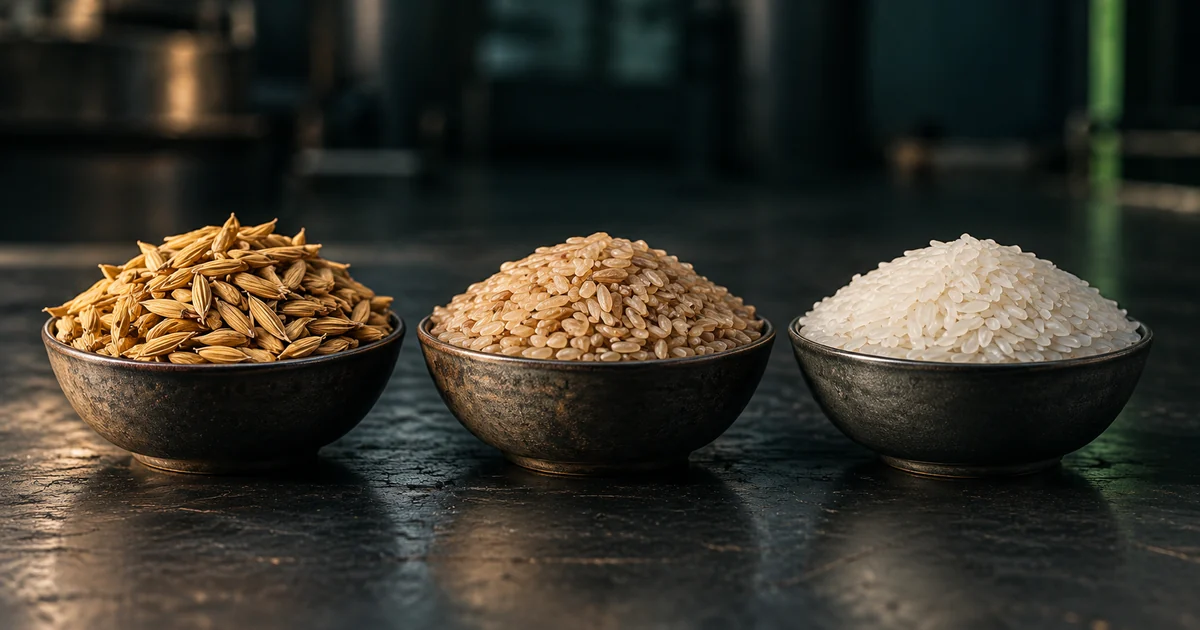
A rice milling process converts raw paddy into polished white rice through a precise sequence of machines - each stage removing impurities, husk, and bran while preserving grain integrity. Understanding this process helps mill operators optimise output, reduce breakage, and improve milled rice quality. This guide covers the complete step-by-step process, process flow chart, machinery, and performance benchmarks from Gold Mohur Overseas, India’s rubber roller manufacturer since 1985.
What Is Rice Milling?
Rice milling is the post-harvest process of removing the outer husk and bran layers from rough paddy (unhusked rice) to produce white rice ready for consumption or export. A modern rice milling unit combines 6-8 machines running in sequence, with each stage feeding directly into the next in a continuous flow.
Rice Milling at a Glance
- Input: Raw paddy (rough rice)
- Output: Milled white rice
- Typical yield: 65-72% of paddy weight
- Husk removed: ~20% | Bran removed: 8-12%
- Key quality metric: Head rice percentage (unbroken grains)
Step-by-Step Rice Milling Process
- Pre-Cleaning - Paddy passes through vibrating sieves and an aspirator to remove straw, dust, chaff, and large foreign matter before milling begins.
- De-Stoning - A specific-gravity de-stoner separates heavy stones and pebbles that could damage downstream machinery.
- Husking (Rubber Roller Huller) - Two counter-rotating rubber rollers apply differential friction to crack and remove the outer husk, producing brown rice.
- Paddy Separation - A paddy separator (indent cylinder or specific gravity table) returns un-husked grains to the husker for reprocessing.
- Whitening - Abrasive or friction whiteners remove the bran layer from brown rice, producing white rice.
- Polishing - A polishing machine smooths the grain surface using water mist or dry friction, improving appearance and shelf life.
- Length Grading - An indent cylinder grader separates head rice (whole grains) from broken rice and small particles.
- Weighing & Packaging - Milled rice is weighed, bagged, and sealed for dispatch or storage.
Rice Milling Process Flow Chart
The flow chart below shows the complete sequence from raw paddy to milled white rice. Note the paddy separator’s return loop - unhusked grains cycle back to the rubber roller husker rather than passing through as brown rice.
Rice Milling Machinery: What Each Machine Does
Pre-Cleaner & De-Stoner
- Vibrating sieves remove straw and chaff
- Aspirator removes light impurities
- De-stoner removes heavy stones by specific gravity
- Critical: protects downstream machines from damage
Rubber Roller Husker
- Two rubber rolls at differential speed
- Removes husk without breaking grain
- Target: <2% broken rice at husking stage
- Roll life: 60-100 tonnes (replace when worn)
Whitening & Polishing
- Whitener removes bran layers (3-5 passes)
- Polisher improves surface appearance
- Water polishing gives translucent grain
- Controls degree of milling (DOM)
Length Grader
- Indent cylinder separates by grain length
- Separates head rice from broken (1/2 and 1/4)
- Head rice commands premium export price
- Broken rice sold separately for flour/brewing
Rice Milling Performance Metrics
| Metric | Target Range | If Below Target |
|---|---|---|
| Milling recovery | 65-72% | Check husker gap, whitener pressure |
| Head rice % | 55-65% | Adjust rubber roller gap, paddy moisture |
| Broken rice % | <15% | Replace worn rollers, check paddy quality |
| Husking efficiency | 85-95% | Tighten roll gap, reduce feed rate |
| Whiteness degree | 38-42 (Kett) | Increase whitener passes or pressure |
Common Rice Milling Problems & Solutions
⚠ High broken rice (>15%)
Causes: worn rubber rolls, roll gap too tight, paddy moisture above 16%, or stones not removed. Fix: replace rubber rollers, widen roll gap, check de-stoner.
⚠ Low milling recovery (<63%)
Causes: excessive whitening, high paddy moisture, poor paddy quality. Fix: reduce whitener passes, check paddy drying, improve pre-cleaning.
ⓘ Husker vibration & noise
Causes: unbalanced rolls, worn bearings, loose mounting. Fix: balance rolls after replacement, check bearings every 500 hours.
FAQ: Rice Milling Process
What is the rice milling process step by step?
Eight steps: (1) pre-cleaning to remove foreign material, (2) de-stoning, (3) husking using rubber roller huskers to strip the outer husk and produce brown rice, (4) paddy separation to return unhusked grains for reprocessing, (5) whitening to remove bran layers, (6) polishing to smooth the grain surface, (7) grading to separate head rice from broken grains, and (8) weighing and packaging for dispatch.
What is the flow chart of the rice milling process?
Rough Paddy → Pre-Cleaner → De-Stoner → Rubber Roller Husker → Paddy Separator (with return loop for unhusked paddy) → Whitening Machine → Polishing Machine → Length Grader → Weighing & Packaging → Milled White Rice.
What are the by-products of rice milling?
Three main by-products: rice husk (~20% of paddy weight - used as fuel or in board manufacturing), rice bran (8-12% - used for bran oil extraction and animal feed), and broken rice (sold for rice flour, brewing, or animal feed).
What is the role of the rubber roller in rice milling?
The rubber roller is the core component of the husking stage. Two counter-rotating rollers apply differential friction to crack and remove the husk from paddy without breaking the grain inside. Roller hardness, differential speed, and roll gap must be calibrated to the paddy variety and moisture content.
How long does the rice milling process take?
In a modern commercial rice mill, paddy completes the full sequence (pre-cleaning to packaging) in roughly 15-20 minutes. The bottleneck is usually drying (if paddy moisture is above 14%) or pre-cleaning when raw paddy has high impurity levels.
What is the difference between brown rice and white rice in milling?
Brown rice is produced after the husking stage - the outer husk is removed but the bran layer remains intact. White rice requires the additional whitening and polishing stages. Brown rice retains more fibre and nutrients; white rice has a longer shelf life. The milling yield for white rice is typically 65-72% of original paddy weight.
Source Rubber Rollers for Your Rice Mill
Gold Mohur Overseas - ISO-certified rubber roller manufacturer since 1985. Supplying to mills across 40+ countries. Custom hardness & dimensions available.
How much rice do you get from 1 kg of paddy?
A well-tuned modern rice mill achieves a milling recovery of about 65-68% (roughly 650-680 g of milled rice per 1 kg of paddy), with head (unbroken) rice typically 50-58%. Actual recovery depends on paddy variety, moisture at milling, and rubber-roller condition.
What are the main types of rice mills?
Three broad types: traditional single-huller (Engelberg/steel) mills, which are low cost but cause higher breakage; modern rubber-roller mills, which husk gently for higher head-rice yield; and compact mini rice mills for small-scale or on-farm milling. Most commercial mills today use rubber-roller husking.
What is rice milling in simple terms?
Rice milling is the process of removing the husk and bran layers from harvested paddy to produce edible brown or white rice, while keeping grain breakage as low as possible.