

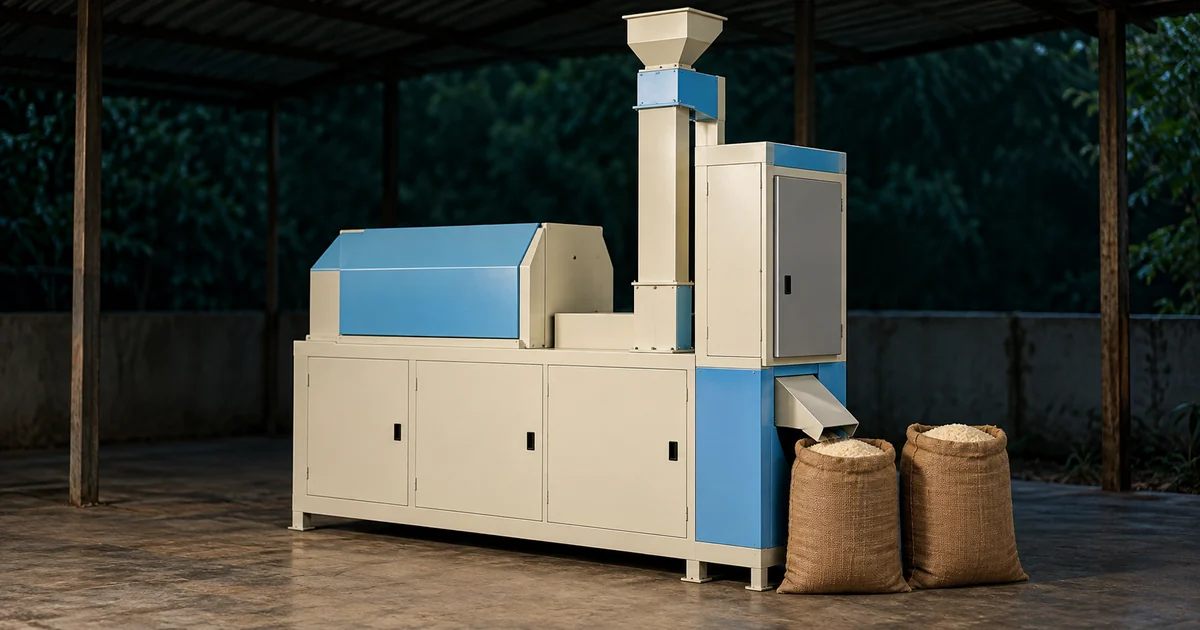
Setting up a mini rice mill is one of the most accessible entry points into agri-processing - low investment, steady local demand, and faster ROI than large commercial mills. This guide covers the complete mini rice mill setup: equipment list, cost in India, production capacity, profit margin, and step-by-step process - from Gold Mohur Overseas, India’s rubber roller manufacturer since 1985.
What Is a Mini Rice Mill?
A mini rice mill (also called a small rice mill or mini rice mill plant) is a compact paddy processing unit that converts raw paddy into finished milled rice. Unlike large commercial mills that process 5-20+ tonnes per hour, a mini rice mill typically handles 0.5-2 tonnes per hour (TPH) - making it ideal for:
- Rural and semi-urban entrepreneurs
- Small-scale farmers looking to add value to their crop
- Community processing centres
- First-time rice mill business owners
- Low-investment, high-return agri ventures
Why Invest in a Mini Rice Mill Business?
📈 Business Advantages
- Low capital investment vs large mills
- High local demand for rice year-round
- Easy raw material (paddy) availability
- Fewer operators needed (2-4 staff)
- Government subsidies available (PMEGP, NABARD)
- Fast ROI: typically 18-36 months
🏭 Operational Advantages
- Compact footprint (800-1,200 sq. ft.)
- Modular - scale up as business grows
- Process both raw and parboiled paddy
- Sell by-products (bran, husk) for extra revenue
- Can run on single-phase or 3-phase power
- Simple machinery, easy to maintain locally
Mini Rice Mill Equipment List
A complete mini rice mill requires the following machines running in sequence. Skipping any stage reduces output quality or increases broken rice percentage:
| Machine | Function | Power (HP) |
|---|---|---|
| Paddy Cleaner | Removes straw, dust, stones before milling | 1-2 HP |
| De-stoner | Separates heavy stones by specific gravity | 0.5-1 HP |
| Rubber Roller Husker | Removes husk using rubber rollers - core machine | 5-10 HP |
| Paddy Separator | Returns un-husked grains to husker | 1-2 HP |
| Whitening Machine | Removes bran layers from brown rice | 5-10 HP |
| Polishing Machine | Smooths grain surface, improves appearance | 3-5 HP |
| Length Grader | Separates head rice from broken | 1-2 HP |
| Elevator / Conveyors | Moves grain between machines | 1-2 HP |
| Packing Machine | Weighs and bags finished rice | 0.5-1 HP |
🆕 The rubber roller is the most critical machine in your mini rice mill. It determines broken rice percentage, husking efficiency, and overall output quality. A worn or wrong-hardness rubber roller increases broken rice by 3-8%, directly cutting your profit margin. Gold Mohur Overseas rubber rollers are used in mini rice mills across India and 40+ countries - specify your paddy type and moisture for the right hardness recommendation.
Step-by-Step: How to Set Up a Mini Rice Mill
- Feasibility & Location - Choose a location with easy paddy supply access, reliable 3-phase power, and 800-1,200 sq. ft. covered space. Proximity to paddy-growing areas reduces raw material cost.
- Business Registration & Licences - Register as MSME/proprietorship. Obtain: FSSAI licence, factory licence (if >10 workers), GST registration, pollution NOC. Apply for PMEGP/NABARD subsidy if eligible.
- Machinery Procurement - Source from verified manufacturers. Prioritise the rubber roller husker quality - it determines your entire output grade. Get quotes for complete turnkey setup vs individual machines.
- Civil Work & Installation - Lay concrete flooring (minimum 4″ thickness), install machine foundations, set up power connection (25-40 HP total load for 1 TPH unit), and ventilation/dust collection.
- Test Run & Calibration - Run the mill with 1-2 tonnes of paddy. Check: husking efficiency (>85%), broken rice % (<15%), whiteness degree (38-42 Kett). Adjust roller gap and whitener pressure.
- Paddy Procurement & Sales Channel - Tie up with local paddy farmers or mandis. Set up rice distribution: local wholesalers, retailers, government procurement (FCI), or direct consumer packing.
Mini Rice Mill Setup Cost in India
Mini rice mill machine price varies by capacity and automation level. Below are realistic 2026 estimates for India:
| Capacity | Setup Cost (₹) | Power Required | Space |
|---|---|---|---|
| 0.5 TPH (basic) | ₹3-8 lakh | 15-20 HP | 800 sq. ft. |
| 1 TPH (standard) | ₹10-18 lakh | 25-35 HP | 1,000-1,200 sq. ft. |
| 2 TPH (commercial) | ₹20-35 lakh | 40-60 HP | 1,500-2,000 sq. ft. |
| 5 TPH (small commercial) | ₹40-80 lakh | 80-120 HP | 3,000+ sq. ft. |
💲 Cost breakdown for a 1 TPH mini rice mill setup: Machinery (husker, whitener, polisher, grader, conveyors) - ₹7-12 lakh | Civil & electrical work - ₹1-3 lakh | Working capital (first paddy stock) - ₹2-5 lakh | Licences & registration - ₹20,000-50,000 | Contingency (10%) - ₹1-2 lakh. Total: ₹11-22 lakh for a fully operational 1 TPH unit.
Production Capacity & Power Consumption
| Metric | 0.5 TPH Unit | 1 TPH Unit | 2 TPH Unit |
|---|---|---|---|
| Paddy processed/day (16 hrs) | 8 tonnes | 16 tonnes | 32 tonnes |
| Rice output/day (~65% yield) | 5.2 tonnes | 10.4 tonnes | 20.8 tonnes |
| Power consumption/day | 120-160 units | 250-350 units | 500-700 units |
| Operators required | 2-3 | 3-4 | 5-7 |
| By-products/day (husk + bran) | ~2.4 tonnes | ~4.8 tonnes | ~9.6 tonnes |
Mini Rice Mill Profit & ROI
Profit from a mini rice mill is driven by four things: the paddy procurement price, the milled-rice selling price, by-product revenue, and running costs. Because the gap between paddy cost and rice price shifts with season and variety, monthly profit is best understood as a margin on throughput rather than a fixed number.
- Net profit margin: small rice mills typically run about 8-15%, with less-automated units at the lower end (2025-26 industry estimates).
- Paddy is the biggest cost: paddy procurement accounts for roughly 65-75% of operating expenses, so buying paddy well is the main profit lever.
- By-products add income: husk, bran and broken rice contribute another 10-20% of total revenue.
- Payback: a well-run small-scale mill typically recovers its investment in about 2-3 years.
In practice, monthly profit scales with how much paddy the mill processes and the margin it holds on each tonne - higher throughput, better paddy sourcing, consistent rice quality, and direct market linkages all lift the bottom line.
Mini Rice Mill vs Large Rice Mill
| Factor | Mini Rice Mill | Large Rice Mill (5+ TPH) |
|---|---|---|
| Setup cost | ₹3-35 lakh | ₹80 lakh-₹5 crore+ |
| Space required | 800-2,000 sq. ft. | 5,000-20,000+ sq. ft. |
| Capacity | 0.5-2 TPH | 5-30+ TPH |
| Operators | 2-5 | 15-50+ |
| ROI period | 18-36 months | 36-72 months |
| Best for | Local markets, rural areas | Export, bulk wholesale |
| Scalability | Add machines as demand grows | Fixed capacity, major CAPEX to upgrade |
FAQ: Mini Rice Mill Setup
How much does a mini rice mill cost in India?
A basic mini rice mill setup in India costs ₹3-8 lakh for a 0.5-1 TPH capacity unit. A complete 1-2 TPH commercial mini rice mill with rubber roller husker, whitener, polisher, and grader costs ₹10-25 lakh depending on brand and automation level. These are indicative 2025-26 market ranges; for a detailed, financeable cost breakdown see NABARD model project reports and MSME project profiles.
What is the profit margin in a mini rice mill?
Net profit margins for small rice mills typically run about 8-15%, with less-automated units at the lower end. Paddy procurement is the largest cost (65-75% of operating expenses), while by-products - husk, bran and broken rice - add another 10-20% of revenue. Monthly profit depends on throughput and the paddy-to-rice price spread rather than a fixed figure. (2025-26 industry estimates.)
How much space is needed for a mini rice mill?
A mini rice mill requires 800-1,200 sq. ft. of covered space for machinery. An additional 500-1,000 sq. ft. is recommended for paddy and finished rice storage. Total site: 1,500-2,000 sq. ft. minimum.
What machines are needed for a mini rice mill?
Core machines: paddy cleaner, de-stoner, rubber roller husker (with rice rubber rollers), paddy separator, whitening machine, polishing machine, length grader, conveyors, and packing machine. Total power requirement: 20-40 HP for a 1 TPH unit.
What is the production capacity of a mini rice mill?
A mini rice mill typically processes 0.5-2 tonnes of paddy per hour. Running 16 hours/day, a 1 TPH unit processes 16 tonnes of paddy, yielding approximately 10-11 tonnes of milled white rice daily (at 65-70% milling yield).
Source Rubber Rollers for Your Mini Rice Mill
Gold Mohur Overseas - ISO-certified rubber roller manufacturer since 1985. Rollers for every capacity: 0.5 TPH to 30+ TPH. Custom hardness for your paddy variety.