

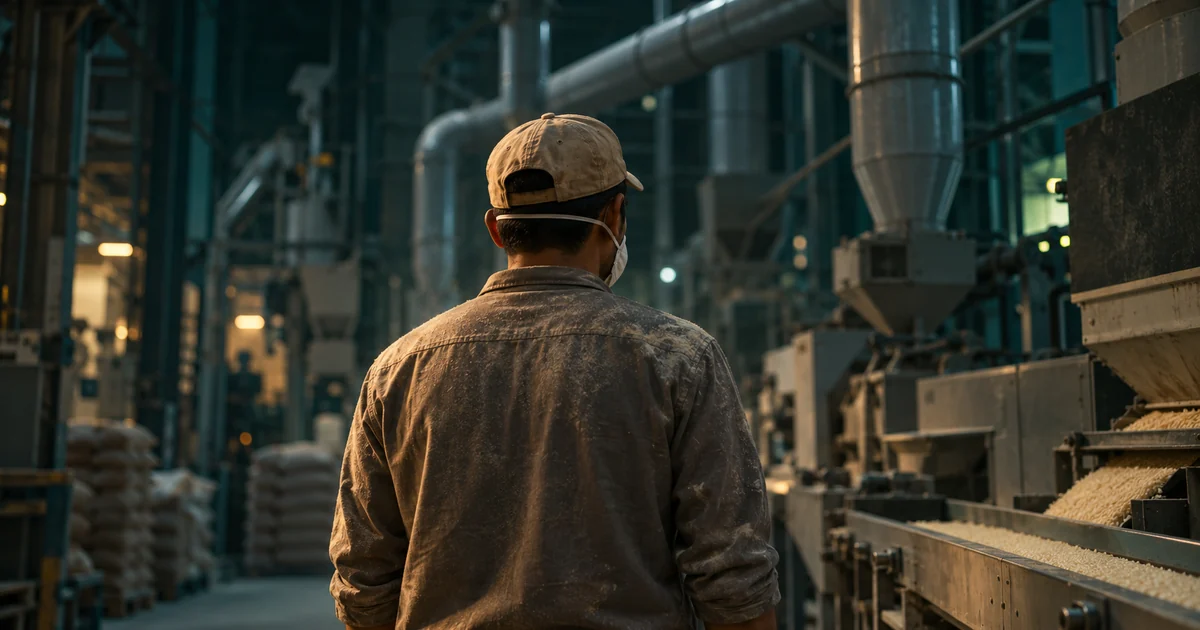
Paddy dust is the most underestimated hazard in a rice mill - invisible during operation, dangerous over time, and a compliance liability that regulators are increasingly enforcing. Effective dust control in rice milling protects your workers’ health, prevents fire risk, and keeps your mill compliant with CPCB regulations. This guide covers sources, health risks, control equipment, and the practical steps to reduce rice mill dust - from Gold Mohur Overseas, India’s rubber roller manufacturer since 1985.
What Is Paddy Dust (Rice Dust)?
Paddy dust (also called rice dust or grain dust) is the fine airborne particulate generated during paddy processing. It is a complex mixture, not just “dust”:
| Component | Source Stage | Particle Size | Hazard |
|---|---|---|---|
| Husk fragments (silica-rich) | Husking / aspiration | 10-500 µm | Silicosis risk with long-term exposure |
| Rice bran particles | Whitening / polishing | 1-50 µm | Respiratory inflammation; combustible |
| Starch dust | Polishing / packing | 5-30 µm | Explosive at high concentration |
| Mold spores | Paddy cleaning (wet paddy) | 2-10 µm | Farmer’s lung (hypersensitivity pneumonitis) |
| Insecticide residue | Paddy from treated storage | Variable | Toxic exposure risk |
Where Paddy Dust Is Generated in a Rice Mill
Every machine in the milling line generates dust at a different intensity. Knowing the primary sources lets you prioritise where to install controls:
🔴 High Dust Generation
- Paddy cleaner: Aspiration of chaff and lightweight impurities
- Rubber roller husker: Husk stripping + air current separation
- Whitening machine: Bran removal generates the finest, most respirable dust
- Polisher: Starch and bran dust from polishing action
🟡 Moderate Dust Generation
- Paddy separator: Vibration shakes loose particles
- Elevator cups: Transfer points drop grain, releasing trapped dust
- Length grader: Cylinder rotation agitates fine particles
- Packing area: Bag filling and weighing creates secondary dust clouds
🔥 Fire risk: Rice dust and husk dust are combustible. The minimum explosive concentration (MEC) of rice starch dust is ~60 g/m³. Accumulated dust on motors, beams, and duct surfaces has caused multiple mill fires in India. Daily cleaning of dust collection equipment is not optional - it is the primary fire prevention measure.
Health Risks of Rice Dust Exposure
Workers in rice mills who are exposed to grain dust without adequate dust control face well-documented occupational health risks:
| Condition | Cause | Onset | Reversible? |
|---|---|---|---|
| Chronic bronchitis | Long-term inhalation of organic dust | 3-10 years | Partially |
| Farmer’s lung | Mold spores in dusty paddy | Weeks-months | If caught early |
| Occupational asthma | Sensitisation to rice bran protein | Months-years | No (sensitisation permanent) |
| Silicosis | Crystalline silica in husk dust | 5-20 years | No |
| Eye irritation | Coarse dust particles | Immediate | Yes |
| Skin sensitisation | Repeated bran dust contact | Months | No (sensitisation permanent) |
📌 Under the Factories Act 1948, the permissible exposure limit (PEL) for grain dust is 4 mg/m³ (8-hour TWA). Workers in a typical uncontrolled rice mill routinely experience 15-40 mg/m³ - 4-10× the legal limit. Labour inspectors can issue stop-work notices under Section 41 of the Factories Act for failure to control dust exposure.
How to Control Dust in Rice Milling: Equipment & Methods
Effective dust control in milling uses a layered approach - primary control (capture at source), secondary control (filter before discharge), and tertiary control (PPE for residual exposure).
1. Cyclone Separators
The first line of dust control - installed at the husker outlet, paddy cleaner, and aspiration channel exhaust. A cyclone uses centrifugal force to separate coarse particles (husk, chaff) from the airstream.
- Efficiency: 80-95% for particles >10 microns
- Captures husk and coarse bran - dischargeable as by-product (fuel, feed)
- Low maintenance: no filter media to replace
- Limitation: does not capture fine respirable dust (<10 µm)
- Mandatory for mills >0.5 TPH under CPCB norms
2. Fabric Bag Filters
Secondary filtration after the cyclone - captures fine dust from whitening, polishing, and secondary aspiration.
- Efficiency: >99% for particles >1 micron
- Filter media: polyester or polypropylene bags (washable or replaceable)
- Must be cleaned by pulse-jet or mechanical shaking - daily in high-dust mills
- Captures bran and starch dust - saleable as defatted bran
- Required for mills with whiteners operating >8 hours/day
3. Aspiration System Design
The aspiration fan and ducting network is the backbone of rice mill dust control. Correct design is critical:
| Parameter | Correct Range | Effect if Wrong |
|---|---|---|
| Duct air velocity | 15-20 m/s | Below 12 m/s: dust settles in ducts. Above 25 m/s: excessive noise and wear |
| Capture velocity at source | 1.5-2.5 m/s | Below 1.5 m/s: dust escapes to room air |
| Negative pressure at husker | 50-100 Pa | Insufficient vacuum = dust blowback into mill |
| Fan capacity (for 1 TPH mill) | 3,000-5,000 m³/hr | Undersized fan cannot maintain velocity at all points |
4. Enclosed Transfer Points
Open grain transfer points - where grain drops from one machine to another or into a hopper - are major dust release points. Solutions:
- Enclosed elevator boots with aspiration connection
- Telescopic spouts on packing hoppers
- Covered conveyor troughs instead of open belts
- Dust curtains at paddy entry/exit points
- Rubber seals on all machine inspection doors
Personal Protective Equipment (PPE) for Rice Mill Workers
Engineering controls come first - PPE is the last line of defence for residual exposure. Required for all workers in active milling areas:
Mandatory PPE
- Respiratory: N95 mask (FFP2) minimum - P100 for whitening area
- Eyes: Safety glasses with side shields
- Hearing: Earplugs or earmuffs (mills exceed 85 dB in whitening area)
- Hands: Cotton gloves - prevents bran sensitisation
Employer Obligations
- Provide PPE at no cost to workers
- Train workers on correct mask fit (seal check)
- Replace N95 masks every shift or when soiled
- Annual pulmonary function tests for long-term workers
- Maintain PPE provision records for labour inspection
Regulatory Compliance: Dust in Indian Rice Mills
Rice mills in India face dust-related compliance under three frameworks:
| Regulation | Authority | Key Requirement |
|---|---|---|
| Factories Act 1948, Schedule I | State Labour Dept | PEL for grain dust: 4 mg/m³ (8-hr TWA). Engineering controls mandatory above PEL. |
| CPCB Emission Standards | CPCB / SPCB | PM10 from agro-industrial stacks ≤150 µg/m³. Cyclones mandatory for huskers. |
| FSSAI Food Safety Regulations | FSSAI | Dust control required in rice packing areas to prevent product contamination. |
| Fire Services Act (State) | State Fire Dept | Combustible dust management plan required for mills above threshold capacity. |
Dust Control Maintenance Checklist
Dust control equipment fails silently - a clogged bag filter looks the same from outside. Schedule these checks:
- Daily: Empty cyclone hoppers. Check bag filter pulse-jet cycle is firing. Verify aspiration fan is running (check amp draw vs baseline).
- Weekly: Inspect cyclone body for buildup. Check all duct joints for leaks (light a match near joints - flame deflects toward leaks). Measure duct velocity at 2 points.
- Monthly: Open bag filter and inspect bags for holes, blinding (caked dust), or collapsed bags. Replace damaged bags. Check fan impeller for dust buildup (causes imbalance).
- Quarterly: Professional dust level measurement in key mill areas. Compare to PEL. Document results for compliance records.
FAQ: Paddy Dust Control in Rice Mills
What is paddy dust and why is it dangerous?
Paddy dust (rice dust) is fine particulate from paddy cleaning, husking, whitening, and polishing. It contains organic particles, silica from husk, and mold spores. Long-term exposure causes chronic bronchitis, occupational asthma, and silicosis. Accumulated rice dust is also a fire and explosion hazard with an MEC of ~60 g/m³.
How to control dust in milling operations?
Dust control requires: (1) Cyclone separators at husker and cleaner outlets; (2) Fabric bag filters for fine dust from whitening; (3) Correctly designed aspiration system (15-20 m/s duct velocity); (4) Enclosed grain transfer points; (5) N95 masks for all workers; (6) Daily cleaning of dust collection equipment.
What is the permissible limit for rice dust in Indian rice mills?
The permissible exposure limit (PEL) for grain dust under the Factories Act 1948 is 4 mg/m³ (8-hour TWA). CPCB requires PM10 emissions below 150 µg/m³ from mill stacks. Uncontrolled mills typically run 15-40 mg/m³ - 4-10× the legal limit.
What equipment is used for dust control in rice mills?
Standard equipment: (1) Cyclone separator - coarse dust (80-95% efficiency >10µm); (2) Bag filter - fine dust (>99% efficiency >1µm); (3) Aspiration fan and ducting; (4) Air lock valves on hoppers; (5) Enclosed conveyors and telescopic packing spouts. All four layers are needed for complete dust control.
Is rice mill dust a fire hazard?
Yes. Rice starch dust has a minimum explosive concentration (MEC) of ~60 g/m³. Husk dust fires have destroyed multiple Indian rice mills. Prevention: daily cleaning of dust collection equipment, no spark sources near dust areas, explosion relief vents on bag filters, and grounded electrical equipment throughout the mill.
Questions About Rice Mill Equipment & Maintenance?
Gold Mohur Overseas specialises in rubber rollers for rice mills across India and 40+ countries. For rubber roller selection, husker maintenance, or milling efficiency questions - our team is available.