

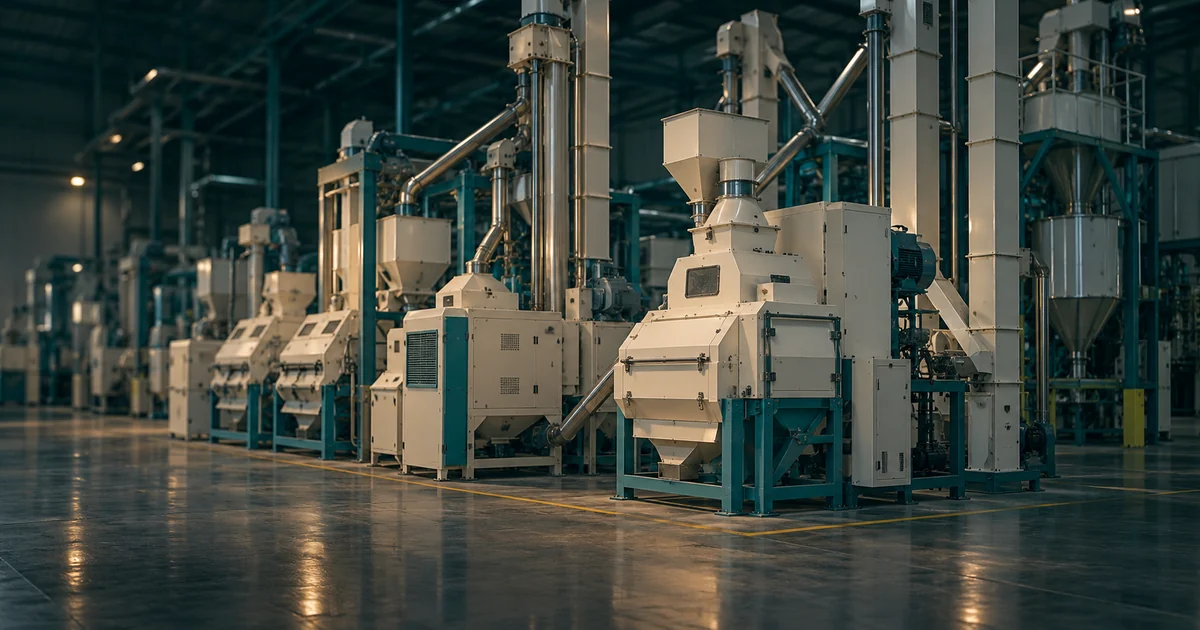
Understanding how a rice mill works at the machine level - not just the flow sequence, but what each machine actually does mechanically, what controls it, and what signals indicate it is functioning correctly - is the foundation of effective mill management. This guide covers the functioning of a rice mill machine by machine: how each operates, the key settings that control it, and the warning signs that something is wrong. For the full paddy-to-white-rice flow chart and process sequence, see our rice milling process guide. From Gold Mohur Overseas, India’s rubber roller manufacturer since 1985.
What does a rice mill do? A rice mill converts harvested paddy into clean, edible rice through a sequence of machines that clean, de-husk, separate, whiten, polish, and grade the grain. Each machine handles one stage, and the paddy flows from one to the next until packaged rice comes out the end. Here’s what each machine does.
Machine 1: Paddy Cleaner
The cleaner is the first machine paddy encounters. Its function is to remove foreign matter before it reaches the husker - where stones or metal can destroy rubber rollers.
How It Works
- Aspiration: air flow removes lightweight material - dust, chaff, empty husks
- Sieves/screens: separate oversize (straw, clumps) and undersize (fine dust, broken grain) from paddy
- De-stoner: fluidised bed or gravity table separates stones (higher specific gravity than paddy)
- Magnetic separator: removes metal fragments before husker
Key control: air flow rate (too high = good paddy carried away; too low = dust passes through). Warning sign: stones appearing in brown rice output - de-stoner overloaded or screen damaged.
Machine 2: Rubber Roll Husker
The husker is the central machine in any rice mill. Its function: remove the outer husk from paddy to produce brown rice.
How It Works
Two rubber rolls spin at slightly different speeds - typically a 1:1.2-1.4 speed ratio. Paddy falls through the gap between the rolls. The speed differential creates friction that grips the husk and strips it from the grain, while the correct gap ensures the grain body is not crushed.
| Control Parameter | Effect | Wrong Setting Sign |
|---|---|---|
| Roll gap | Controls husking pressure on grain | Too tight: high breakage. Too wide: low husking efficiency |
| Speed differential | Controls friction force on husk | Reduced ratio: low husking efficiency |
| Feed rate | Controls paddy volume through gap | Overfeeding: rolls slip, husking drops |
| Roll condition | Grip and gap geometry | Worn rolls: rising breakage, recirculation above 12% |
Output: mixture of brown rice, unhusked paddy (~5-15%), loose husk, and husk fragments. This mixture goes to the husk aspirator and then the paddy separator.
Machine 3: Husk Aspirator
Immediately after the husker, an aspirator uses controlled air flow to separate loose husk from the grain+paddy mixture. The husk is lighter and is carried by air to a cyclone separator and then to husk storage or a boiler. The grain+paddy stream falls through for paddy separation.
Key control: air velocity - must be high enough to carry husk but not so high that brown rice is aspirated. Warning sign: husk appearing in the brown rice stream - air flow too low.
Machine 4: Paddy Separator
The paddy separator’s function is to return unhusked paddy from the husker output back to the husker for a second pass, while sending brown rice forward to the whitener.
How It Works
Oscillating trays with specific surface coatings exploit the difference in surface texture between husked brown rice (smooth bran) and unhusked paddy (rough husk). Brown rice slides off the tray surface; paddy grips and rides upward to be discharged separately and recirculated to the husker. The separator slope, oscillation speed, and tray surface condition all affect separation efficiency.
Warning signs: paddy appearing in the whitener feed (separator not separating) - check tray slope and surface condition. Brown rice going to recirculation (waste) - check tray slope calibration.
Machine 5: Whitener
The whitener removes the bran layer from brown rice to produce white rice. This is the highest-breakage-risk stage in the mill - grain is under abrasive pressure and any weakness from upstream (cracks from husking, dry paddy) manifests here as broken grain.
How It Works
Brown rice is fed into a chamber where a spinning abrasive wheel (emery roll or stone) removes bran by friction against a fixed mesh screen. The bran passes through the screen as bran flour; white rice exits through the end of the chamber. Whitening pressure is controlled by the resistance at the discharge end.
- Too much pressure: high breakage, over-whitened grain
- Too little pressure: bran remains on grain, whiteness below target
- Worn wheel: glazed - energy rises, whiteness drops, breakage increases
- Screen damage: rice passes through screen - yield loss
Machine 6: Polisher (Optional)
Polishing adds shine and removes the fine bran dust that remains on white rice after whitening. Required for premium retail and export grades. Two types:
- Water polisher: fine water mist added during friction polishing - produces bright, glossy grain. Risk: over-wetting causes clumping and quality issues
- Friction polisher: leather or rubber friction rollers create shine without water - gentler, lower breakage
Machine 7: Grader (Sifter/Length Grader)
The grader separates white rice by grain length, removing broken grains from the head rice stream. The grade of broken rice determines its price - 25% broken, 5% broken, and full head rice are priced differently. Grading is what converts milled white rice into a sellable grade.
How it works: vibrating sieves with specific mesh sizes. Indented cylinder graders sort by grain length - short broken grains fall into cylinder indents; long head rice rides over the indents and exits separately.
Rice Mill Working: Performance Indicators per Machine
| Machine | Normal Performance | Warning Signal |
|---|---|---|
| Cleaner | Zero stones in brown rice stream | Stones at husker, screen tears |
| Husker | 85-95% husking per pass, <4% breakage | Recirculation above 12%, rising breakage |
| Paddy separator | Paddy in white rice below 0.1% | Paddy in whitener feed, brown rice in recirculation |
| Whitener | Target whiteness at correct pressure | Rising current, falling whiteness, breakage spike |
| Polisher | Consistent shine, no clumping | Wet clumps, uneven finish, breakage increase |
| Grader | Clean head rice grade, correct broken % separation | Head rice contaminated with brokens, screen blocking |
📌 Most rice mill performance problems trace back to one of two root causes: worn consumable components (rubber rolls, whitening wheels, separator tray surfaces, grader screens) or incorrect control settings (gap, pressure, air flow). A systematic audit of both - see our machinery audit guide - catches most issues before they become failures.
FAQ: How a Rice Mill Functions
How does a rice mill work?
Paddy passes through: (1) Cleaner - removes stones/dust; (2) Husker - rubber rolls remove husk to produce brown rice; (3) Paddy separator - returns unhusked grain to husker; (4) Whitener - abrasive wheel removes bran; (5) Polisher - adds shine; (6) Grader - separates by length/broken %; (7) Packing.
What are the main functions of a rice mill?
A rice mill performs six core functions to turn paddy into edible rice: (1) cleaning - removing stones, dust and chaff; (2) dehusking (hulling) - stripping the outer husk to produce brown rice; (3) paddy separation - returning unhusked grain for a second pass; (4) whitening - removing the bran layer; (5) polishing - improving grain shine; (6) grading - sorting whole rice from broken. Alongside white rice, the mill also recovers saleable by-products - husk, bran and broken rice. (Source: IRRI Rice Knowledge Bank.)
What is the function of a rubber roller husker in a rice mill?
Two rubber rolls at slightly different speeds create friction that strips the husk from paddy while leaving the bran intact. Gap and speed ratio are the key controls. Output: brown rice + unhusked paddy + husk - separated downstream.
What does a paddy separator do in a rice mill?
Separates unhusked paddy from brown rice using surface texture difference. Brown rice (smooth bran) slides off oscillating trays; paddy (rough husk) grips and rides up to be recycled to the husker. Without a separator, unhusked paddy contaminates the white rice output.
What is the difference between whitening and polishing in rice milling?
Whitening: abrasive wheel removes the bran layer from brown rice. Polishing: secondary finish using water mist or friction to add shine to white rice. Whitening is mandatory; polishing is optional, required only for premium retail and export grades.
Why does a rice mill have a paddy separator after the husker?
No husker achieves 100% efficiency - typically 85-95% per pass. The separator identifies the remaining unhusked grain and returns it for a second pass. Without a separator, unhusked paddy would appear in the white rice output - a quality failure in any grade.
Rubber Rollers That Hold Their Gap Across Every Shift
The husker is where rice mill performance begins. Gold Mohur Overseas supplies matched rubber roller pairs, Shore A certified, for all major husker makes. ISO-certified manufacturer since 1985.
What does a grader do in a rice mill?
The grader (length grader or sifter) separates whole head rice from broken grains by size, so the mill can bag uniform, higher-value rice and channel brokens to their own grade. Consistent grading directly affects the price the mill gets per bag.