

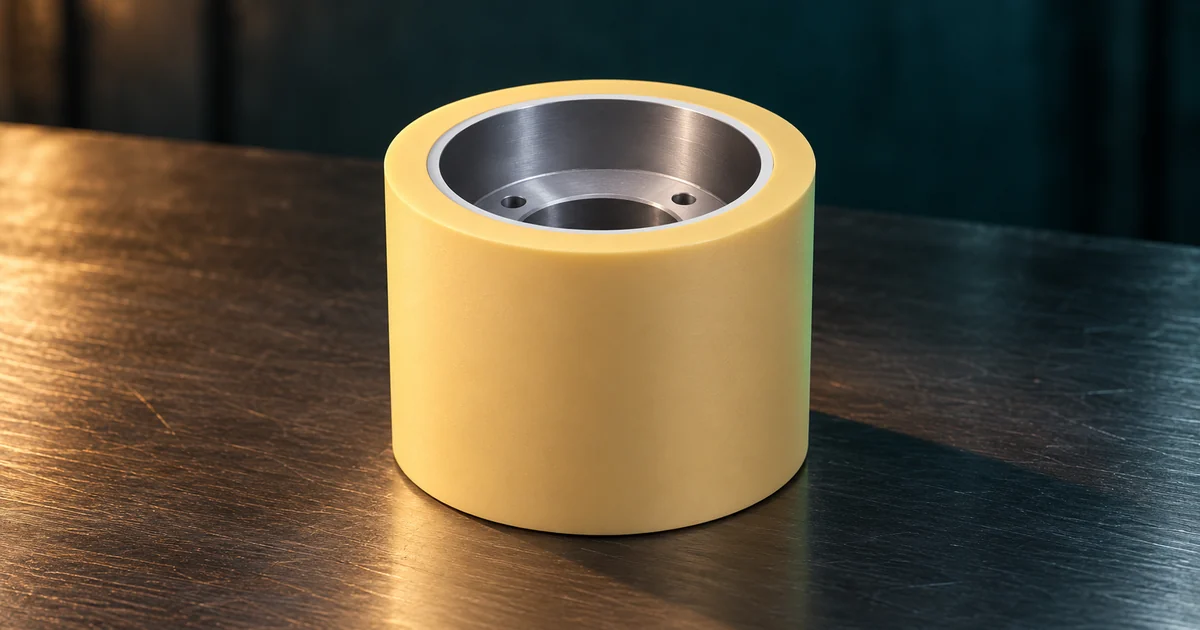
Rubber rollers in a rice husker operate under continuous compressive load, friction heat, and ambient temperature - all of which affect performance and lifespan. Two specifications that most mill operators never read on their roller datasheets - temperature rating and load rating - directly determine how the roller behaves in summer heat, high-throughput runs, and parboiled paddy milling. This guide explains what these ratings mean and how to operate within them. From Gold Mohur Overseas, manufacturing rice rubber rollers since 1985.
Why Temperature Affects Rubber Roller Performance
Rubber is a viscoelastic material: its mechanical properties change with temperature. Shore A hardness - the key performance parameter of a rice rubber roller - decreases as temperature rises:
| Roll Surface Temperature | Shore A Change | Effect on Milling |
|---|---|---|
| 25°C (standard test temp) | Baseline | As specified |
| 40°C | −2 to −4 Shore A | Slight softening, minor grip increase |
| 60°C | −5 to −10 Shore A | Significant softening, faster wear, gap drift |
| 80°C | −10 to −18 Shore A | Rubber oxidation begins, permanent hardness loss |
| Above 90°C | Major degradation | Surface cracking, roll failure |
A 65 Shore A roller specified for your husker may be operating at effective 55-58 Shore A on a 45°C summer afternoon in a poorly ventilated mill. This is equivalent to using the wrong hardness roller - with all the consequences for husking efficiency and breakage.
Temperature Limit for Rice Rubber Rollers
The safe operating temperature limit for most rice rubber rollers is 60°C surface temperature. Above this threshold:
- Rubber softens beyond the acceptable performance band for the specified Shore A grade
- Wear rate increases exponentially - rolls wear 2-3x faster above 65°C than at 40°C
- Rubber-to-metal bond weakens - risk of delamination under load
- Nitrile rubber tolerates slightly higher temperatures than natural rubber (rated to 70-80°C vs 60-65°C for NR)
How to Measure Roll Temperature in the Field
Use an infrared (IR) thermometer or contact pyrometer. Measure at the roll surface mid-width, 15 minutes after startup and again at 2 hours. If surface temperature exceeds 55°C at 2 hours, investigate: check ventilation, throughput rate, gap setting, bearing condition, and ambient temperature.
What Causes Rubber Rollers to Overheat?
| Cause | Mechanism | Fix |
|---|---|---|
| Gap too tight | Excess compression generates internal heat in rubber | Readjust gap - check with feeler gauge |
| Throughput above rated capacity | More grain per minute = more heat per unit time | Reduce feed rate to rated TPH |
| Worn bearings | Bearing heat transfers via shaft to roll core | Inspect and replace bearings |
| Poor mill ventilation | Ambient temp above 40°C accelerates all heat build-up | Add ventilation or roof insulation |
| Parboiled paddy | Harder grain generates more friction heat per pass | Use nitrile rubber rolls rated for higher temp |
Load Rating: What It Is and Why It Matters
The load rating of a rice rubber roller is the maximum compressive force (in kg or kN) the rubber can sustain without permanent deformation. Operating above the load rating:
- Causes permanent compression set - the roll does not spring back to full diameter after load
- Accelerates wear by 3-5x compared to within-rating operation
- Creates flat spots on the roll surface that cause vibration and uneven husking
- Increases broken rice % due to variable gap pressure
Typical Load Ratings by Roll Specification
| Roll Diameter | Width | Shore A | Approximate Load Rating |
|---|---|---|---|
| 220mm | 150mm | 60 | 500-700 kg |
| 300mm | 150mm | 65 | 800-1,200 kg |
| 300mm | 200mm | 65 | 1,100-1,600 kg |
| 380mm | 200mm | 70 | 1,500-2,200 kg |
Actual load ratings vary by manufacturer and compound. Ask for the load rating specification when ordering rolls for high-throughput or parboiled rice applications.
How to Extend Roller Life: Temperature and Load Management
- Check mill ventilation. Aim for ambient mill temperature below 38°C at roll height. Roof vents or forced-air fans on husker area reduce ambient by 5-10°C.
- Do not exceed rated throughput. Feed rate above the husker’s rated TPH creates overloading before the gap even becomes a problem.
- Check gap setting after any load increase. Higher throughput may require a slightly wider gap to compensate for increased grain pressure.
- Use nitrile rolls for parboiled and hot environments. NBR compound tolerates 70-80°C vs 60-65°C for natural rubber.
- Monitor bearing temperature separately. A bearing running above 70°C is transferring heat to the roll shaft. Replace the bearing before it causes roll damage.
- Allow rolls to cool between shifts. Stopping the husker 10-15 minutes before the end of the shift before turning off ventilation allows the roll surface to cool below 40°C before restart.
📌 In Indian summer conditions (April-June), mill ambient temperatures of 42-48°C are common in poorly ventilated buildings. Combined with parboiled rice processing, roll surface temperatures can reach 75-85°C - significantly reducing roll life. Roof insulation + a forced-air fan at roll level is often the most cost-effective roller life extension available.
FAQ: Rubber Roller Temperature & Load Ratings
What temperature limit applies to rice rubber rollers?
Safe operating limit: 60°C surface temperature. Above this, rubber softens significantly (hardness drops 5-10 Shore A), wear accelerates 2-3x, and rubber-to-metal bond weakens. Nitrile rubber tolerates slightly higher temperatures (70-80°C) than natural rubber.
What causes rubber rollers to overheat in a rice mill?
(1) Gap too tight; (2) Throughput above rated capacity; (3) Worn or misaligned bearings; (4) Ambient temperature above 40°C with poor ventilation; (5) Parboiled rice generating more friction heat than raw paddy.
What is the load rating of a rice rubber roller?
Maximum compressive force the rubber sustains without permanent deformation. A standard 300mm, 150mm wide, 65 Shore A roll handles 800-1,200 kg. Operating above this rating causes permanent compression set, flat spots, and 3-5x faster wear.
Does rubber roller hardness change with temperature?
Yes. At 40°C: 2-4 Shore A softer than rated. At 60°C: 5-10 Shore A softer. A 65 Shore A roller may be operating at 55-58 Shore A on a hot summer afternoon - equivalent to using the wrong grade roller.
How do I know if my rubber rollers are overloaded?
Signs: rolls wearing faster than expected for the tonnage, permanent flat spots on roll surface, roll diameter reducing unevenly, rolls hot to touch (above 50°C) within 30 minutes of startup, increased broken rice % without a gap change.
Rollers Rated for Indian Operating Conditions
Gold Mohur Overseas supplies natural rubber and nitrile rubber rolls, specified for your paddy type, throughput, and ambient temperature. Temperature and load ratings provided on request.