

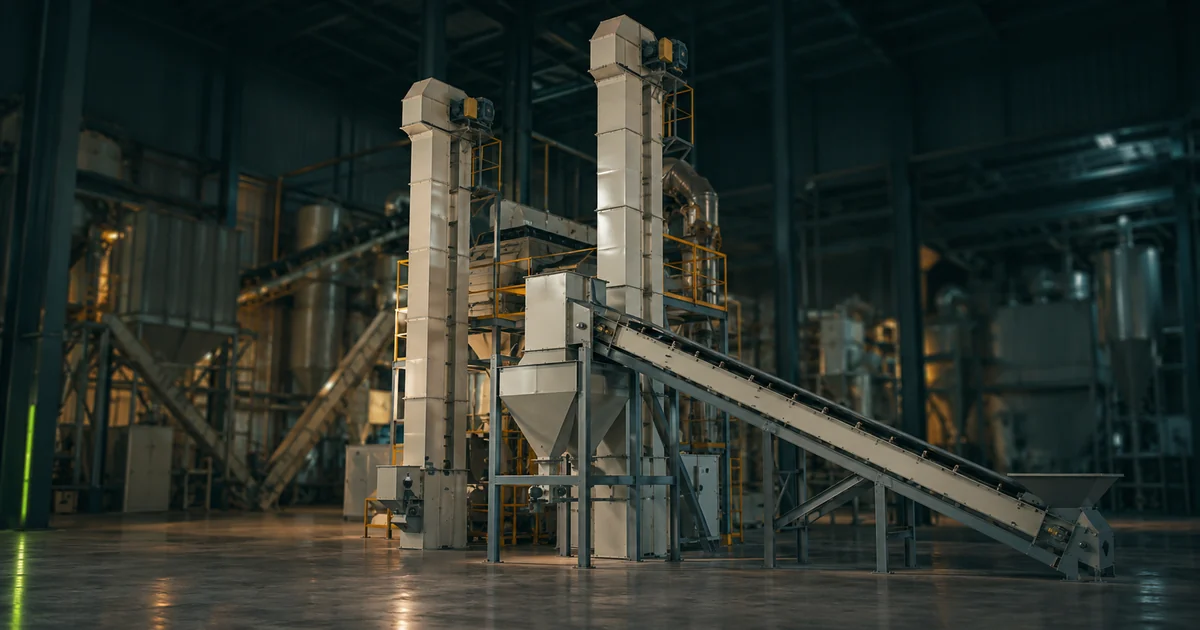
The processing machines in a rice mill - husker, whitener, polisher, grader - are connected by a material handling network that most mill owners never audit. Yet this network determines whether the mill actually runs at its rated throughput or limps at 60-70% capacity due to bottlenecks, spillage, and grain breakage in transit. This guide covers the key systems in rice mill material handling - bucket elevators, belt conveyors, screw conveyors, and pneumatic systems - with common failure points and upgrade options. From Gold Mohur Overseas.
Why Material Handling Is the Hidden Throughput Bottleneck
A mill rated at 2 TPH can only process as fast as its slowest material handling link allows. Common situations:
- A 1.5 TPH elevator feeding a 2 TPH husker - the husker runs at 75% utilisation
- A screw conveyor running at 80% fill with wet paddy - clogs every 2-3 hours
- A bucket elevator with worn buckets - 10-15% grain spilling back at the boot
- A gravity spout with too much drop height - 3-5% grain breakage just in transit
Material handling problems manifest as throughput caps, grain breakage that appears to come from the whitener or polisher (but originates in conveyors), and unexplained maintenance hours spent on spillage cleanup.
Bucket Elevators: Vertical Movement
The bucket elevator is the backbone of a multi-floor rice mill. Paddy arrives at floor level; machines are typically stacked vertically so gravity assists movement between stages. Bucket elevators do the lifting.
Key Specifications
| Parameter | Typical Range | Common Failure |
|---|---|---|
| Capacity | 1-20 TPH | Undersized for actual throughput |
| Belt speed | 1-2.5 m/s | Too fast = grain thrown at discharge, breakage |
| Bucket spacing | 200-400mm | Too close = grain caught between buckets at boot |
| Bucket lip condition | No jagged edges | Worn metal lips crack grain on every scoop |
| Boot pulley clearance | Grain flows freely | Tight clearance = grain crushed at loading |
Maintenance That Prevents Breakage
- Inspect bucket lips every 3 months - replace buckets with bent or jagged lips
- Check belt tension monthly - slack belt causes buckets to drag at the boot
- Verify boot clearance when replacing buckets - new deeper buckets may need boot adjustment
- Clean boot section weekly - grain accumulation at the boot causes crushing
Belt Conveyors: Horizontal and Inclined Transport
Belt conveyors handle horizontal and low-angle inclined runs. They are the gentlest conveying method for fragile basmati and long-grain rice. Key design rules for a rice mill conveying system:
- Maximum incline without grain rolling back: 18-20° for paddy, 15-18° for milled rice
- Belt speed: 0.5-1.5 m/s - higher speeds at discharge increase grain impact
- Limit drop height at discharge to under 400mm - use chutes, not open drops
- Skirt boards on both sides to prevent spillage at feed points
- Rubber-lined or fabric-lined transition chutes - metal-to-metal grain impact breaks long grains
Screw Conveyors: Enclosed Short-Run Transport
Screw conveyors are space-efficient for horizontal and slightly inclined short runs - typically used for by-products (husk, bran, broken rice) rather than whole grain because the screw action is harder on fragile grain.
- Fill level: maximum 45% of trough cross-section - overfilling causes grain to be crushed between screw flight and trough
- Clearance between screw flight and trough: 6-12mm - worn clearances above 15mm reduce efficiency and increase breakage
- Not recommended for basmati or long-grain milled rice - grain length exceeds screw clearance and breaks
- Good for: paddy husk, rice bran, broken rice, paddy cleanings
Pneumatic Conveying: High-Speed Dust and Husk Handling
Pneumatic systems use air pressure or suction to move husk, dust, and light fractions away from processing machines. They are not suitable for whole grain (too much breakage) but are the standard for husk extraction and dust collection in modern mills.
- Positive pressure systems: push air + material through pipes (husk to boiler or baler)
- Negative pressure (suction) systems: pull dust and husk off machines into cyclone separators
- Air velocity must be matched to material density - too low = settling, too high = pipe wear
- Cyclone efficiency: well-designed cyclone captures 90-95% of husk; remainder filtered by bag house
Common Material Handling Upgrade Priorities
| Problem | Fix | Investment |
|---|---|---|
| Elevator capacity below husker rating | Replace with higher-capacity elevator or add parallel unit | ₹40,000-1,50,000 |
| Grain breakage at discharge points | Add rubber-lined chutes, limit drop to 400mm | ₹5,000-20,000 |
| Spillage at conveyor feed points | Add skirt boards + feed hopper | ₹3,000-10,000 |
| Husk clogging mill environment | Add suction husk aspirator + cyclone | ₹20,000-60,000 |
| Manual grain scooping between machines | Add interconnecting conveyor or elevator | ₹15,000-50,000 |
📌 Audit your material handling before buying new processing machines. A 2 TPH husker fed by a 1.5 TPH elevator runs at 75% utilisation regardless of husker quality. Most throughput complaints that lead to husker or whitener replacement are actually material handling bottlenecks. Audit first; upgrade second.
FAQ: Material Handling in Rice Mills
What is material handling in a rice mill?
All equipment moving paddy, brown rice, white rice, and by-products between processing stages. Key equipment: bucket elevators, belt/screw conveyors, grain distributors, pneumatic husk extractors. Poor material handling creates bottlenecks that cap throughput below machine-rated capacity.
What is a bucket elevator in a rice mill?
A vertical conveying system lifting grain between floors. A continuous belt with buckets scoops grain at the bottom, carries it to the top, and discharges into the next machine. Common failure points: worn bucket lips, belt slip, tight boot clearance causing grain crushing.
What causes grain breakage in rice mill conveyors?
(1) Conveyor speed too high; (2) Drop height above 400mm at discharge; (3) Sharp bends or transition points; (4) Screw conveyor running overfull; (5) Elevator buckets hitting the boot pulley. Most conveyor breakage can be fixed with chute modifications and speed reduction.
What is the difference between belt and screw conveyors in rice mills?
Belt conveyors: gentle, for horizontal and inclined runs up to 20°, preferred for whole grain. Screw conveyors: compact, enclosed, harsher on grain, better for by-products (husk, bran). Use belt for milled rice; screw for husk and bran handling.
How do I reduce grain breakage in rice mill material handling?
(1) Limit drop heights to under 400mm; (2) Reduce conveyor and elevator speeds; (3) Use rubber-lined boot sections and chutes; (4) Replace worn bucket lips; (5) Inspect all transition points quarterly for sharp edges and misalignment.
Rubber Rolls for Your Husker - Matched to Your Mill
Gold Mohur Overseas supplies matched rubber roller pairs for all major husker makes and models. ISO-certified since 1985. Specify your husker and paddy variety when ordering.