

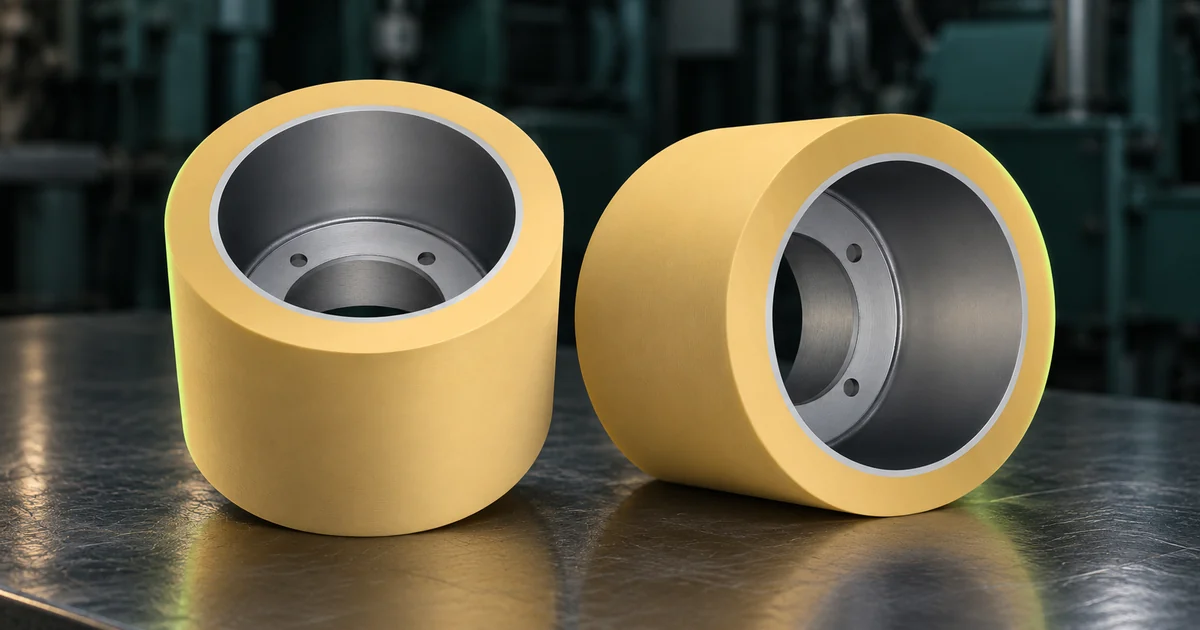
In a rice husker, two rubber rolls spin at slightly different speeds to create the friction that removes the husk. When those rolls are balanced - matched in diameter, hardness, and mass - the gap pressure is even across the grain and husking is consistent. When they are imbalanced, the consequences are measurable: higher breakage, lower head rice recovery, vibration damage, and accelerated bearing failure. This guide covers why balancing rice rubber rolls matters and exactly what to do about it. From Gold Mohur Overseas, India’s rubber roller manufacturer since 1985.
How Rubber Roll Balance Affects Husking
A husker’s rubber rolls work as a matched pair. The fixed roll and the adjustable roll spin at set speeds, and the grain passes through the gap under controlled pressure. When both rolls are identical in diameter and hardness:
- Surface speed differential is consistent across the full roll width
- Gap pressure is even - each grain receives the same husking force
- Husking efficiency is predictable - typically 85-95% per pass
- Breakage stays within spec - typically 2-4% for well-calibrated rolls
When rolls are mismatched, the gap geometry changes. The roll with the larger diameter closes the gap more, creating a pressure hot spot - and the smaller-diameter side runs too loose. Grain through the hot spot cracks; grain through the loose side passes unhusked.
What Causes Roll Imbalance?
1. Replacing One Roll Instead of Both
The most common cause in Indian mills. A new roll has a larger diameter than a worn partner. The diameter difference - even 1-2mm - creates speed differential imbalance. On a 300mm diameter roll, 2mm diameter difference = ~0.7% surface speed difference. Small in theory; significant in practice when sustained over every grain.
2. Uneven Wear Within a Pair
The driven roll (the one connected to the belt) always wears faster than the idler roll because it bears the torque load. Even matching rolls purchased together will diverge in diameter if not tracked. At 40 tonnes of paddy, the diameter difference can reach 3-5mm if untreated.
3. Mixed Hardness Compounds
Using rolls from different manufacturers or different batches with different Shore A hardness values creates hardness imbalance. A 60-Shore roll paired with a 65-Shore roll deforms differently under pressure - the softer roll flattens more, effectively widening the gap on that side.
Effects of Imbalanced Rolls: What You Will Actually See
| Symptom | Root Cause (Imbalance) | Financial Impact |
|---|---|---|
| Vibration in husker frame | Mass imbalance creates oscillating force | Bearing damage, frame fatigue, loosening of fasteners |
| Increased broken rice % | Hot spots at smaller-gap zones crush grain | 2-5% more broken rice = ₹15,000-40,000/month on 1 TPH |
| Inconsistent husking (paddy in white rice) | Loose zones pass grain unhusked | Sorting cost, reprocessing, customer complaints |
| One bearing running hot | Uneven load distribution on shaft | Premature bearing failure - ₹2,000-8,000 + downtime |
| Higher paddy recirculation rate | More unhusked grain returned for reprocessing | 3-8% more energy, lower throughput |
Best Practices for Balanced Rubber Roll Operation
- Always replace as a pair. Never install one new roll against a used roll. The cost saved on one roll is lost within 1-2 shifts of breakage.
- Source matched pairs from the same batch. Same manufacturer, same compound, same production run ensures consistent hardness.
- Track diameter monthly. Measure roll diameter with calipers at three points along the width. Replace when either roll drops below 95% of original diameter, or when the pair shows more than 2mm diameter differential.
- Balance paddy feed. Ensure paddy flows evenly across the full roll width. Channelled feeding (all grain in one lane) causes localised wear and breaks roll balance faster.
- Check gap setting after each replacement. A new pair requires gap resetting from scratch - do not assume the old gap setting is correct for new rolls.
- Keep a roll log. Record installation date, initial diameter, and tonnage processed. Review the log monthly. This is the only reliable way to stay ahead of imbalance.
How to Diagnose Imbalance: A Simple Field Check
You do not need instruments for a first-pass diagnosis. Run the husker empty and observe:
- Smooth, low vibration: rolls are likely balanced
- Rhythmic thumping (1-3 Hz): mass imbalance - check if one roll is significantly more worn
- High-frequency vibration: bearing issue or surface damage - inspect bearing and roll surface
- Noise with paddy running, not empty: gap setting issue or inconsistent paddy flow, not roll imbalance
⚠ If you find significant vibration, stop and inspect before continuing. Operating a husker with severe roll imbalance accelerates bearing wear by 3-5x and can cause shaft damage that costs 10-20x more than the replacement rolls.
Paired Roll Specification: What to Specify When Ordering
| Specification | Standard Range | Why It Matters for Balance |
|---|---|---|
| Shore A Hardness | 55-75 Shore A (by paddy type) | Both rolls must be within ±2 Shore A of each other |
| Diameter tolerance | ±0.5mm on nominal | Wider tolerance = faster imbalance onset |
| Rubber compound | Natural / nitrile blend | Same compound = same wear rate |
| Width match | Must equal husker working width | Narrower roll = localised pressure, faster eccentric wear |
📌 Gold Mohur Overseas supplies matched pairs from the same production batch, with Shore A tolerance control and diameter matched to ±0.3mm. Request matched pairs explicitly when ordering - specifying your husker make, model, and paddy type.
FAQ: Balancing Rice Rubber Rolls
What is rubber roll balancing in rice milling?
Balancing means ensuring a pair of rubber rolls have equal diameter, hardness, and mass so they spin at the same effective surface speed. Imbalanced rolls create unequal pressure, causing inconsistent husking, higher breakage, and accelerated bearing wear.
What causes rubber rolls to become unbalanced?
(1) Uneven wear - the driven roll wears faster than the idler; (2) Replacing one roll instead of both; (3) Different hardness compounds from different batches; (4) Uneven paddy feeding across roll width. Most common cause: replacing one roll instead of the pair.
What are the signs of imbalanced rubber rolls?
(1) Vibration in husker frame; (2) Uneven husking - some grain husked, some not in same pass; (3) Increased broken rice %; (4) One bearing running hotter; (5) Unusual thumping noise; (6) Paddy spraying off rolls instead of controlled flow through gap.
Should I replace rubber rolls one at a time or as a pair?
Always as a pair. A new roll paired with a worn roll creates immediate diameter imbalance - uneven gap pressure, higher breakage. The cost saving of one roll is eliminated by yield loss within 1-2 shifts.
How often should rubber rolls be replaced to maintain balance?
Replace pairs every 60-80 tonnes for basmati, 80-120 tonnes for parboiled. Track with calipers - replace when either roll drops below 95% of original diameter or the pair shows more than 2mm diameter differential.
Order Matched Rubber Roll Pairs
Gold Mohur Overseas supplies matched pairs from the same production batch - Shore A controlled, diameter matched to ±0.3mm. Specify your husker model and paddy type when ordering.