

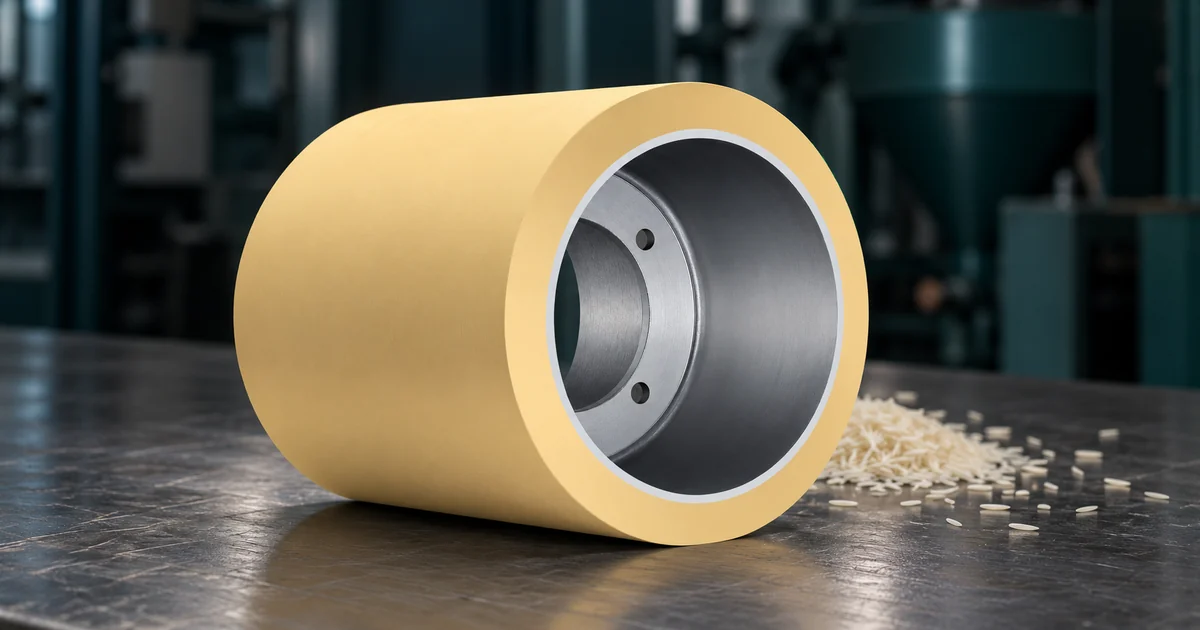
1121 basmati is India’s highest-value export rice variety - and the most demanding to mill without breakage. Its extreme grain length (7.8-8.4mm raw, expanding to 22-24mm cooked) makes every husker setting that works for shorter varieties a potential source of yield loss. This guide covers the grain characteristics of 1121 basmati that drive specific milling requirements - husker gap, rubber roll hardness, moisture, and replacement intervals - so you can set up your mill correctly before the first tonne is processed. From Gold Mohur Overseas, India’s rubber roller manufacturer since 1985.
1121 Basmati Grain Characteristics That Drive Milling Decisions
To set up a husker correctly for 1121, you need to understand what makes this grain different from standard varieties:
| Characteristic | 1121 Basmati | Sona Masuri (Comparison) | Milling Implication |
|---|---|---|---|
| Raw grain length | 7.8-8.4mm | 5.2-5.8mm | Longer contact zone on roll - higher fracture risk |
| Grain thickness | 1.8-2.2mm | 1.6-1.9mm | Requires wider gap setting than shorter varieties |
| Grain fragility | High (slender body) | Medium | Lower pressure required - softer roll compound |
| Husk adhesion | Moderate | Moderate | Standard husking pressure range |
| Moisture sensitivity | Very high | Moderate | Tight moisture control - below 12% = severe breakage |
| Cooked length | 22-24mm | 8-10mm | Lengthwise fractures invisible raw, visible when cooked |
⚠ The 1121 breakage trap: Lengthwise fractures from incorrect husker settings are not visible in dry milled grain. They only show up on the cooked plate as split or shortened grains - after the rice has left your mill. This is the primary quality complaint from 1121 buyers.
Rubber Roll Hardness for 1121 Basmati
The correct Shore A hardness for 1121 basmati husking is 85-90 Shore A - the softest end of the rice mill roller range.
Why Softer Rubber Matters for Long Grain
When a long grain passes through the roll gap, it contacts the rubber across its full 8mm length simultaneously. A harder roll (85-90 Shore A) does not deform at contact points - it concentrates pressure at the grain’s widest cross-section. On a 1121 grain, this concentrated pressure creates an internal stress fracture along the grain body. The husk is removed, the grain passes grading, but the structural crack opens on cooking.
A softer roll (85-90 Shore A) deforms slightly under the long grain, distributing pressure across the full contact length rather than concentrating it. This is the mechanical reason for the softer compound recommendation - not brand preference.
Husker Gap Setting for 1121 Paddy
1121 paddy grain thickness: 1.8-2.2mm (measure your own lot - thickness varies by crop season and origin).
Correct gap: 0.1-0.2mm less than grain thickness = 1.6-2.0mm at the roll nip.
| Paddy Thickness (measured) | Correct Gap | If Gap is Tighter |
|---|---|---|
| 2.2mm | 2.0-2.1mm | Breakage spike, lengthwise fractures |
| 2.0mm | 1.8-1.9mm | Breakage spike at narrower gap |
| 1.8mm | 1.6-1.7mm | High sensitivity - verify with feeler gauge |
Always verify with feeler gauges, not by feel. The gap that felt correct for your previous lot may be 0.2-0.3mm tight for a 1121 lot from a different origin.
Moisture Requirements for 1121 Basmati Husking
1121 paddy is more moisture-sensitive than any shorter variety. The operating window is narrow:
- Below 12%: grain is brittle - even correct gap and correct roll hardness cause breakage. Do not process.
- 12-13%: borderline - slightly wider gap recommended. Monitor breakage in first 5 minutes.
- 13-14%: optimal - correct settings produce normal breakage rates.
- 14-15%: acceptable - slight husking efficiency reduction. Acceptable for most grade specifications.
- Above 15%: husk adhesion increases significantly - husking efficiency drops, recirculation rises above 15%.
Measure moisture of every incoming 1121 lot with a calibrated moisture meter. Do not rely on supplier-stated moisture - storage conditions and transit time change moisture content significantly.
Rubber Roll Replacement Interval for 1121 Milling
Replace rolls every 60-80 tonnes of 1121 paddy processed. Key points:
- Soft compound (85-90 Shore A) wears slightly faster than harder grades - track tonnage carefully
- Always replace as matched pairs - 1121 grain is sensitive to even small gap imbalances from mismatched roll diameters
- Measure roll diameter monthly: replace when either roll drops below 95% of original diameter
- Do not extend the interval on 1121 - the breakage cost in the last 10-15 tonnes before a worn roll is replaced exceeds the cost of a new pair
Common 1121 Milling Problems and Their Root Causes
| Problem | Root Cause | Fix |
|---|---|---|
| High breakage at whitener (grain splits on cooking) | Husker gap too tight or roll hardness too high | Widen gap 0.1-0.2mm; switch to 85-90 Shore A rolls |
| Low husking efficiency, high recirculation | Paddy moisture above 15% or gap too wide | Check moisture; tighten gap incrementally |
| Breakage spike on first batch | Paddy moisture below 12% or wrong gap from previous variety | Check moisture; reset gap for 1121 thickness |
| Rising breakage mid-shift (was fine at start) | Worn roll pair passing 80-tonne threshold | Check roll diameter; replace if below 95% of original |
| Uneven whiteness after whitening | Upstream breakage creating grain size variation at whitener | Fix husker - whitener cannot compensate for husking damage |
📌 1121 basmati commands a 15-30% price premium over standard white rice. A 2% improvement in head rice recovery on 1121 is worth ₹1,04,000-1,14,000/month on a 1 TPH mill (and higher for 1121 given its price premium). The difference between correct and incorrect husker setup for this variety - gap, roll hardness, moisture - is where that premium is earned or lost.
FAQ: 1121 Basmati Milling
What makes 1121 basmati rice difficult to mill?
Its extreme grain length (7.8-8.4mm raw) makes it fragile under husking pressure. Standard settings for shorter varieties cause 8-15% more breakage. Lengthwise fractures from incorrect settings are invisible in dry milled grain but appear on the cooked plate as split or shortened grains.
What rubber roll hardness is recommended for 1121 basmati milling?
85-90 Shore A. Softer rubber distributes pressure across the full grain length rather than concentrating it at contact points - the mechanical reason for lower breakage on long-grain varieties. Harder rolls (above 65 Shore A) create point pressure that causes lengthwise fracture on 1121.
What husker gap setting is correct for 1121 basmati paddy?
0.1-0.2mm less than grain thickness. 1121 paddy is 1.8-2.2mm thick - correct gap is 1.6-2.0mm. Always verify with feeler gauges. The gap correct for your previous variety will likely be 0.2-0.3mm tight for 1121.
How often should rubber rolls be replaced when milling 1121 basmati?
Every 60-80 tonnes. Always as matched pairs. Soft compound wears slightly faster than harder grades. Replace when either roll drops below 95% of original diameter - do not extend interval on 1121.
What moisture level is correct for milling 1121 basmati?
13-14% is optimal. Below 12%: do not process - severe breakage regardless of correct settings. Above 15%: husking efficiency drops. 1121 is more moisture-sensitive than shorter varieties - measure every incoming lot.
Soft-Grade Rubber Rolls for 1121 & Long-Grain Basmati
Gold Mohur Overseas supplies 85-90 Shore A matched pairs specifically for basmati and long-grain milling. Specify your variety and husker model when ordering. ISO-certified since 1985.