

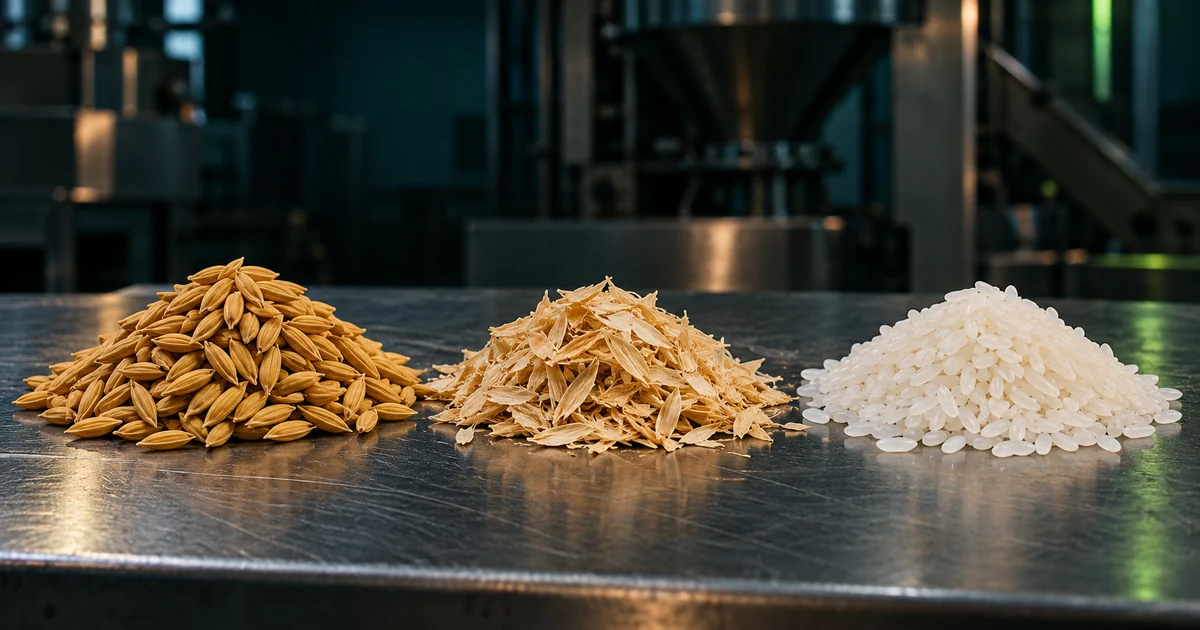
When paddy (rough, unhusked rice) is milled, only part of its weight becomes edible white rice. The rest leaves as husk, bran, and germ. Knowing exactly how much rice you get from paddy matters for costing, procurement, and judging how well a mill performs. This guide gives the paddy-to-rice conversion figures, explains the difference between hulling percentage and milling percentage (a distinction most sources get wrong), and covers what makes recovery rise or fall.
Quick answer: how much rice from 1 kg of paddy?
1 kg of paddy yields roughly 650-680 g of milled white rice, a milling recovery of about 65-68% in a well-run modern mill. The remaining weight leaves as husk (around 20%) and bran (8-12%) (IRRI). For government-procured paddy, the Food Corporation of India fixes a standard out-turn ratio of 67%: 67 kg of rice per 100 kg of paddy for raw rice, and 68% for parboiled (CAG of India).
Paddy-to-rice conversion table
Based on an average milling recovery of 65-68%, with 67% as the FCI benchmark (CAG of India):
| Paddy quantity | Milled rice (at 67%) | Typical range (65-68%) |
|---|---|---|
| 1 kg | 670 g | 650-680 g |
| 10 kg | 6.7 kg | 6.5-6.8 kg |
| 100 kg | 67 kg | 65-68 kg |
| 1 quintal (100 kg) | 67 kg | 65-68 kg |
| 1 tonne (1,000 kg) | 670 kg | 650-680 kg |
These are whole-mill figures (total milled rice, broken grains included). The share of unbroken head rice is lower, as explained below.
Hulling percentage vs milling percentage: what is the difference?
These two terms are constantly mixed up, which is why you will see conflicting numbers online. They measure two different stages:
- Hulling percentage is the yield of brown rice (husk removed, bran still on) as a share of paddy weight. Because husk is about 20% of paddy, hulling percentage is typically 78-80%, and 72-82% for traditional scented and basmati varieties (ScienceDirect).
- Milling percentage (milling recovery) is the yield of finished white rice (husk and bran both removed) as a share of paddy weight. This is the 65-68% figure, because whitening removes a further 8-12% as bran.
The often-quoted “hulling percentage of 60-65%” is really the milling recovery, or the combined output of an old single-pass huller, not true hulling. Getting this right is the difference between a correct yield estimate and a costly one. For the machinery behind husk removal, see our rice huller machine guide.
The formulas:
- Hulling % = (weight of brown rice / weight of paddy) x 100
- Milling % = (weight of white milled rice / weight of paddy) x 100
- Head rice yield % = (weight of whole, unbroken milled rice / weight of paddy) x 100
What happens to the weight: the paddy breakdown
In an ideal mill, 100 kg of paddy separates into roughly these fractions (IRRI):
| Fraction | Share of paddy | What it is |
|---|---|---|
| Husk (hull) | ~20% | Outer lemma and palea, removed during hulling |
| Bran and germ | 8-12% | Removed during whitening and polishing |
| Milled white rice | 68-72% | Edible endosperm (total milled rice) |
The exact split shifts with variety and how much bran is polished off (the degree of milling). Whiter, more-polished rice means a slightly lower milled-rice yield. The husk and bran removed here are not waste; they become saleable by-products, as covered in our rice mill waste management guide.
Head rice yield: why unbroken rice is what really pays
Total milled rice includes broken grains, which sell for less. Head rice yield, the share of whole, unbroken kernels, is the figure that decides a mill’s profitability, and it typically runs 50-58% of paddy. A mill can hit 67% total recovery yet still lose money if breakage is high and head rice is low.
Why milling recovery varies
Two mills running the same paddy can post different recoveries. The main drivers:
- Paddy moisture. Milling is best done at about 14% moisture (IRRI). Over-dry grain shatters; damp grain gums up and mills poorly. See paddy moisture content and dehusking for the safe range.
- Variety and grain shape. Long, slender basmati grains break more easily than short, bold grains.
- Drying method. Fast, uneven drying causes internal cracks (fissures) that turn into broken rice at milling.
- Mill type. Modern rubber-roll shellers husk gently and preserve whole grains, while old steel-drum (Engelberg) hullers husk and whiten in one harsh pass, giving lower total recovery and far more breakage. Our rubber roller vs steel huller comparison covers the yield gap in detail.
- Degree of polishing. Heavier polishing lifts appearance but lowers weight yield.
How to improve rice recovery and head rice yield
- Mill at the right moisture. Condition paddy to about 14% before milling, and dry it slowly to avoid fissuring.
- Use rubber-roll hulling, not steel hullers. A rubber-roll sheller removes husk by gentle friction between two rollers, so far more grains survive whole. This is where rice rubber rollers directly affect yield: worn or mismatched rollers raise breakage and drop head rice. Raw and parboiled paddy each mill best on rollers matched to the grain, from raw paddy rubber rolls to parboiled paddy rubber rolls.
- Keep the two stages separate. Hull first (husk removal), then whiten in a controlled step, rather than doing both in one aggressive pass.
- Maintain roller clearance and replace rollers on schedule. Correct nip settings and fresh rubber keep hulling efficiency high and breakage low. Gentle whitening with well-kept rice polishing wheels protects head rice at the polishing stage.
For the full sequence from paddy to packaged rice, see our step-by-step rice milling process guide.
Frequently asked questions
How much rice do you get from 100 kg of paddy?
About 65-68 kg of milled white rice, with 67 kg being the standard FCI out-turn ratio for raw rice (68 kg for parboiled). The rest leaves as husk (about 20 kg) and bran (8-12 kg).
What is the hulling percentage of rice?
Hulling percentage is the yield of brown rice (husk removed) from paddy, typically 78-80%, and 72-82% for basmati and scented varieties. It is often confused with milling recovery (white rice), which is lower at 65-68%.
What is the milling percentage of rice?
Milling percentage, or milling recovery, is the yield of finished white rice as a share of paddy weight, usually 65-68% in a modern Indian mill and 68-72% under ideal conditions.
What is 70% milled rice?
It refers to a milling recovery of 70%, meaning 70 kg of white rice from 100 kg of paddy. It is achievable with good-quality paddy, correct moisture, and efficient, well-maintained milling machinery.
What is the paddy-to-rice conversion ratio in India?
The working ratio is about 1.5 kg of paddy per 1 kg of milled rice (a 67% out-turn). The Food Corporation of India fixes 67% for raw rice and 68% for parboiled rice from procured paddy.
Why is head rice yield lower than milling recovery?
Milling recovery counts all milled rice, including broken grains. Head rice yield counts only whole, unbroken kernels (typically 50-58% of paddy) and is the figure that most affects a mill’s revenue.
Sources
- IRRI Rice Knowledge Bank, Milling and processing (grain composition, milling fractions, 14% moisture)
- ScienceDirect, Milling quality of rice (hulling percentage for basmati and scented rice)
- Comptroller and Auditor General of India, Procurement and Milling of Paddy (FCI 67% out-turn ratio)