

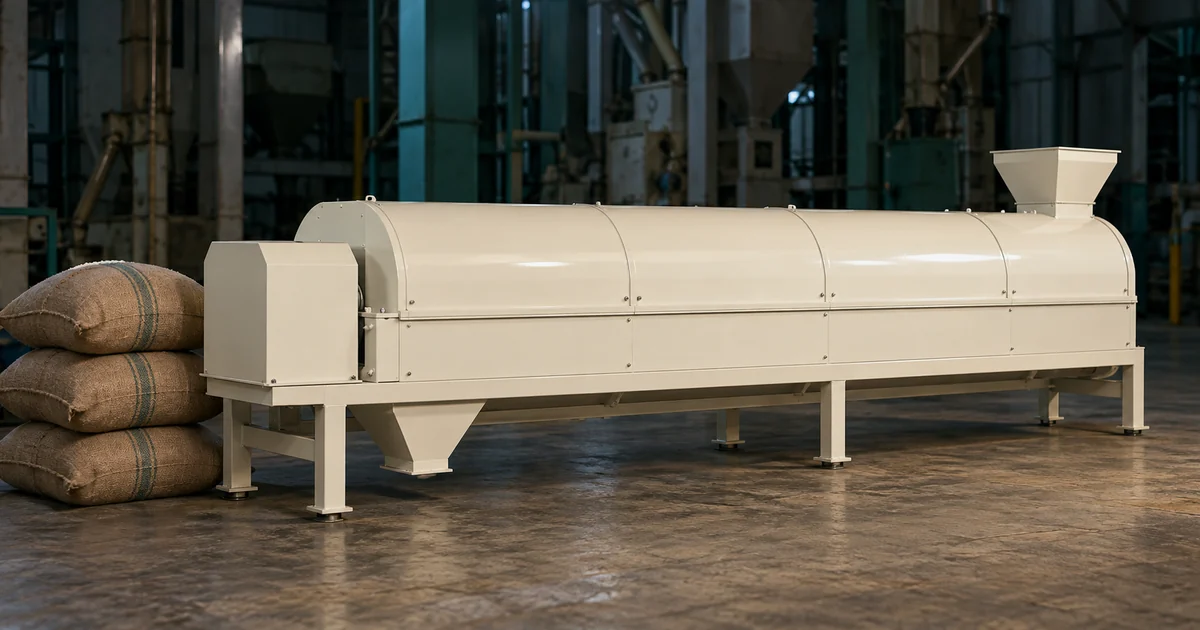
A rice grader machine is the last quality gate in a rice mill. After the rice is hulled, whitened, and polished, the grader sorts the grains by size and length so that whole “head rice” is separated from broken kernels. Because the share of broken grains decides both the grade and the selling price, the grader is what turns milled rice into a market-ready, correctly-classified product. This guide explains the types of rice graders, how each one works, and how grading sets the final rice grade.
What is a rice grader machine?
A rice grader is a machine that classifies milled (white) rice by grain dimensions, mainly length, to separate unbroken head rice from broken pieces and small immature grains. It sits near the end of the milling line, after whitening and polishing and before bagging. Grading does not change the rice; it sorts what the mill has already produced, which is why the grade a mill achieves depends heavily on how gently the paddy was hulled and polished upstream.
Types of rice graders
Three grader types are used in Indian rice mills, often in combination:
| Grader type | How it separates | Best for |
|---|---|---|
| Length grader (indented cylinder / trieur) | By grain length: pockets on a rotating cylinder lift short broken pieces out, whole grains pass over | Separating head rice from brokens (most common) |
| Thickness / width grader (sieve or plansifter) | By thickness and width: oscillating screens let smaller grains fall through | Removing immature and small grains |
| Rotary / drum grader | By size: a rotating perforated drum classifies grains continuously | Continuous, high-volume grade sorting |
How a length grader (indented cylinder) works
The length grader is the workhorse of modern mills. It uses one to three rotating cylinders whose inner surface is covered in small indented pockets (which is why it is also called a trieur). As the cylinder turns, short broken kernels drop into the pockets, are lifted up, and fall into a central trough, while longer whole grains stay in the cylinder body and discharge separately (IRRI). Well-set indented cylinders can reach separation efficiencies above 95%.
Head rice vs broken rice: what grading decides
Head rice is a whole, unbroken kernel, defined as a grain that is at least three-quarters of its full length; anything shorter is counted as broken (FAO). A well-run mill typically produces 50-60% head rice, 5-10% large brokens, and 10-15% small brokens (IRRI). Since head rice sells at a premium and brokens at a discount, the grader directly protects the mill’s revenue. This is the same head-rice figure that drives milling economics, explained in our guide to how much rice you get from paddy.
Rice grade and the Indian standard
In India, procured rice must meet the Uniform Specifications set by the Department of Food and Public Distribution. For raw rice, the maximum permitted broken content is 25% for both Grade A and Common rice, and for parboiled rice it is 16%; brokens smaller than one-eighth of a kernel are treated as foreign matter (FCI Uniform Specifications). A correctly-set grader is how a mill keeps broken content inside these limits and avoids rejection.
Does a rice grader control dust?
No. A grader sorts grains by size and length; it does not remove dust, husk fines, or bran powder. That job belongs to the aspirator or de-duster earlier in the line. Graders are often installed alongside aspiration so that clean, dust-free rice reaches the grading stage, but the two functions are separate.
Key specifications to check when buying a rice grader
- Capacity: from about 500 kg/hr for compact units to 3-5 tons/hr for commercial mills.
- Number of grades: more cylinders or screens allow more output grades (for example, head rice, large broken, small broken).
- Motor power: commonly 0.5 HP to 3 HP depending on capacity.
- Build material: mild steel (MS) or galvanised iron (GI) with easy-to-clean, replaceable cylinders or sieve decks.
How grading fits with the rest of the mill
A grader can only sort the rice it receives; it cannot un-break a grain. The way to raise head rice is to reduce breakage upstream: hull gently with well-matched rice rubber rollers instead of harsh steel hullers (see rubber roller vs steel huller), and whiten in controlled stages with well-kept rice polishing wheels. When hulling and polishing are gentle, the grader has fewer brokens to remove and the mill holds a higher grade. For where the grader sits in the full line, see our machine-by-machine rice mill guide.
Frequently asked questions
What is a rice grader?
A rice grader is a machine that sorts milled rice by length and size to separate whole head rice from broken and small immature grains, setting the final rice grade before packing.
How does a rice length grader work?
It uses rotating indented cylinders whose pockets lift short broken kernels into a central trough while longer whole grains pass through, separating rice by length with over 95% efficiency when correctly set.
What is head rice?
Head rice is a whole, unbroken kernel that is at least three-quarters of its full length. A good mill produces about 50-60% head rice, which sells at a premium over brokens.
What is a paddy grader machine?
A paddy grader classifies paddy or brown rice by thickness and width, usually to remove immature and small grains, whereas a rice length grader sorts finished white rice by length to separate head rice from brokens.
Does a rice grader remove dust?
No. Dust, husk fines, and bran powder are removed by the aspirator or de-duster. The grader only sorts grains by size and length.
How is rice grade checked in India?
Procured rice is checked against the Department of Food and Public Distribution’s Uniform Specifications, which cap broken content at 25% for raw rice and 16% for parboiled rice, among other quality limits.
Sources
- IRRI Rice Knowledge Bank, Milling systems (grader types, indented cylinder, head rice and broken percentages)
- FAO, Physical grain characteristics and grades of rice (head rice and broken definitions)
- Department of Food and Public Distribution, Uniform Specifications (broken rice limits for procurement)