

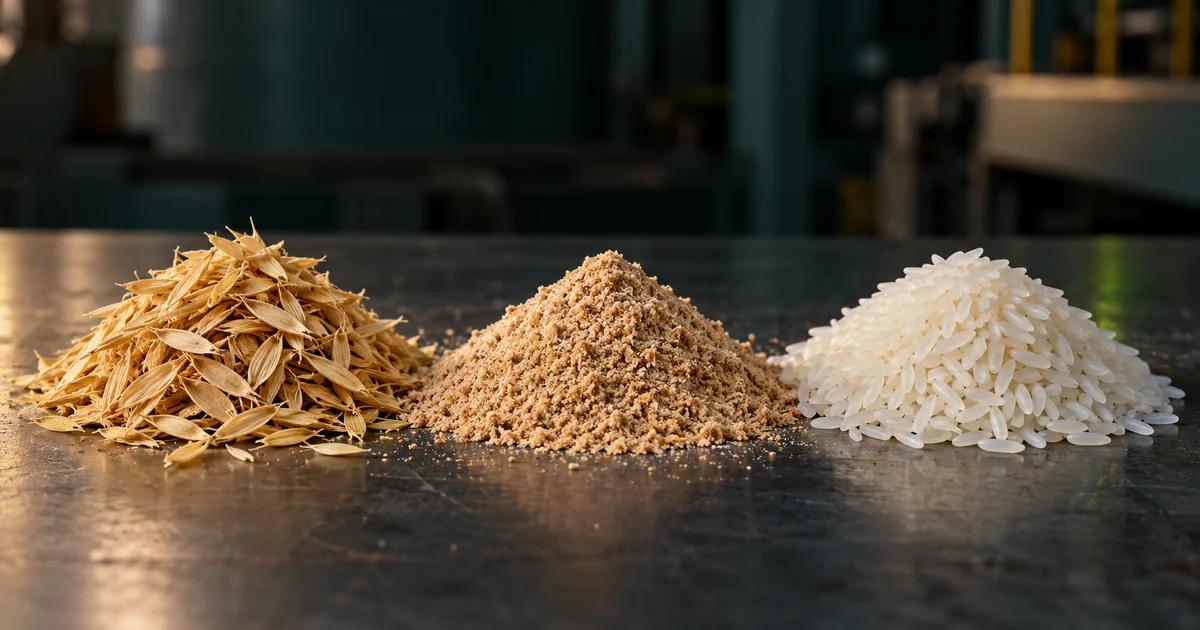
A rice mill doesn’t just produce rice - it produces revenue from waste. Rice mill waste management done right turns what most millers treat as a disposal problem into a secondary income stream that can add roughly ₹8-10 lakh per month to a 1 TPH operation. This guide covers all rice mill by-products, their commercial value, responsible disposal, and compliance requirements in India - from Gold Mohur Overseas, India’s rubber roller manufacturer since 1985.
What Are the By-Products of Rice Milling?
Every 100 kg of paddy that enters a rice mill produces approximately the following output mix. Understanding this breakdown is the first step in effective rice mill waste management:
| By-product | % of Paddy | Qty per 100 kg paddy | Market Value |
|---|---|---|---|
| Milled White Rice | 62-68% | 62-68 kg | Primary revenue |
| Rice Husk (Hull) | 20-22% | 20-22 kg | ₹1-2/kg |
| Rice Bran | 8-10% | 8-10 kg | ₹15-25/kg |
| Broken Rice | 5-15% | 5-15 kg | ₹18-22/kg |
| Germ | 1-2% | 1-2 kg | ₹30-50/kg (specialty) |
📈 A well-run 1 TPH mill processing 16 tonnes of paddy per shift generates: ~3.2-3.5 tonnes of husk + 1.3-1.6 tonnes of bran + 0.8-2.4 tonnes of broken rice per day. At current market rates, these by-products are worth ₹30,000-40,000 per day - often uncaptured by millers who treat them as waste.
Rice Husk: The Highest-Volume By-Product
Rice husk (hull) is the outermost layer removed during dehusking. At 20-22% of paddy weight, it is the largest by-product by volume - and historically the most undervalued.
🔥 Fuel & Energy
- Boiler fuel for brick kilns (most common use in India)
- Rice husk gasifiers - generates syngas for power
- Biomass power plants - 1 kg husk = 3,000-3,500 kcal
- Self-powered mills: use husk to run own boiler
- Price: ₹1-2/kg at mill gate
🏭 Industrial Use
- Rice Husk Ash (RHA) - 92% amorphous silica
- RHA used in cement, steel, and semiconductor industries
- Silica extraction for electronics - premium pricing
- Lightweight aggregate for construction
- Abrasives and filter media
🌿 Agriculture & Other
- Bedding material for poultry and livestock
- Soil amendment - improves drainage
- Mushroom cultivation substrate
- Composting material
- Packaging cushioning (replacing Styrofoam)
Rice Bran: The Highest-Value By-Product
Rice bran is removed during the whitening and polishing stages. At ₹15-25/kg, it is the most valuable by-product per kilogram - and most millers still sell it cheap to intermediaries rather than capturing its full value.
| Bran Product | Price (₹/kg) | Buyer | Notes |
|---|---|---|---|
| Raw rice bran | ₹15-20 | Oil extractors, brokers | Must be stabilised within 4-6 hrs of milling or enzyme activity reduces oil content |
| Stabilised rice bran | ₹20-28 | Oil mills, export | Heat-treated to inactivate lipase; shelf life 6+ months |
| Defatted bran (after oil extraction) | ₹12-18 | Poultry, aquaculture feed | Still 14-16% protein; high feed value |
| Rice bran oil (extracted) | ₹120-160/kg | Edible oil market, cosmetics | Requires bran oil extraction plant - capital intensive |
🆕 Critical timing: Raw rice bran begins losing oil content within 4-6 hours of milling due to lipase enzyme activity. Mills that bag and sell bran within 2-4 hours of production get maximum price. Mills that let bran sit overnight lose 20-30% of its oil value. Bran stabilisation equipment (steam or extrusion) extends shelf life and commands a ₹5-8/kg premium.
Broken Rice: Reducing Waste at the Source
Broken rice is not traditional “waste” - it is a quality problem that becomes a by-product. A mill producing 10% broken rice on a 1 TPH unit loses ~1.6 tonnes/day of product that sells for 30-40% less than whole rice. Reducing broken rice % is the highest-ROI intervention in rice mill waste management.
Causes of High Broken Rice %
- Paddy moisture too low (<11%) - brittle grains crack
- Worn or wrong-hardness rubber rollers
- Incorrect roller gap setting
- Paddy not cleaned before milling (stones crack grains)
- Excessive whitener pressure
- Chalky paddy varieties (inherently weak grain structure)
Revenue from Broken Rice
- Rice flour manufacturing - ₹20-25/kg
- Rice starch production for paper, textiles
- Poultry and aquaculture feed - ₹18-22/kg
- Brewing and fermentation industry
- Extruded snack/puffed rice raw material
- Baby food and weaning food blends
Wastewater Management in Rice Mills
Rice mill waste products also include process water from grain washing, whitening, and floor cleaning. CPCB classifies rice mills as Green Category - but wastewater discharge still requires compliance.
- Volume: 2-5 litres of wastewater per kg of paddy processed - a 1 TPH mill generates 2,000-5,000 litres per 8-hour shift
- Key pollutants: suspended solids (bran particles), BOD from starch and bran oils, occasionally pH imbalance
- Treatment options: Settling tanks + primary clarifier (sufficient for most mills), constructed wetlands, or biogas digesters for high-volume operations
- Discharge standard: BOD ≤30 mg/L, TSS ≤100 mg/L before discharge to surface water
- Treated water reuse: Settled water can irrigate paddy fields - compliant and zero-discharge
Dust & Air Emission Control
Paddy dehusking, whitening, and polishing generate fine rice dust. Without dust control, mills face SPCB compliance issues and occupational health risks.
| Dust Source | Control Equipment | Regulatory Requirement |
|---|---|---|
| Husker outlet | Cyclone separator | Mandatory for capacities >0.5 TPH |
| Whitener/polisher | Fabric filter (bag filter) | Mandatory for all commercial mills |
| Aspiration channel | Aspiration + cyclone | Required - husk separation |
| Paddy storage area | Covered storage + ventilation | FSSAI food safety compliance |
Rice Mill By-Product Revenue: A Real Calculation
Here is a realistic monthly revenue calculation for a 1 TPH mill’s by-products (400 tonnes paddy processed in 25 days):
| By-product | Quantity/Month | Price | Monthly Revenue |
|---|---|---|---|
| Rice husk | 80-88 tonnes | ₹1.50/kg avg | ₹1,20,000-1,32,000 |
| Rice bran (stabilised) | 32-40 tonnes | ₹22/kg avg | ₹7,04,000-8,80,000 |
| Total by-product revenue | - | - | ₹8,24,000-10,12,000/month |
Bran is by far the highest-value stream. Broken rice (another 8-15% of paddy) is graded rice sold separately at ₹18-22/kg, so it is not counted here as a waste by-product.
📌 By-product revenue of roughly ₹8-10 lakh/month is effectively free cash flow on top of the primary rice margin. Most millers leave it on the table by selling husk to local brick kilns at ₹0.50/kg instead of ₹1.50/kg, or letting bran degrade before sale. A basic by-product management protocol - weighing, timing, and buyer relationships - adds this income without any capital investment.
FAQ: Rice Mill Waste Management
What are the by-products of rice milling?
The main by-products of rice milling are: rice husk/hull (20-22% of paddy), rice bran (8-10%), broken rice (5-15%), and germ (1-2%). Each has established commercial markets - rice husk for fuel and silica, bran for oil extraction and feed, broken rice for flour and poultry feed.
How can rice mill waste be converted to revenue?
Rice husk sells to brick kilns or power plants at ₹1-2/kg. Stabilised rice bran fetches ₹20-28/kg from oil extractors. Broken rice sells for ₹18-22/kg for flour or feed. A 1 TPH mill can generate roughly ₹8-10 lakh/month in by-product revenue (mainly from bran) with proper timing and buyer relationships.
What is the use of rice husk in waste management?
Rice husk is used as boiler fuel for brick kilns (₹1-2/kg), raw material for Rice Husk Ash (RHA) used in cement and steel industries, silica extraction for electronics, and construction aggregate. It is the largest by-product by volume - a 1 TPH mill produces ~5 tonnes of husk per 16-hour shift.
What are rice mill pollution control requirements in India?
Rice mills must comply with: CPCB/SPCB dust emission norms (cyclone separators mandatory), wastewater discharge standards (BOD ≤30 mg/L), covered solid waste storage for husk and bran, and noise limits. Green Category classification makes licensing straightforward but non-compliance leads to closure orders.
How much rice bran is produced per tonne of paddy?
A rice mill produces 80-100 kg of rice bran per tonne of paddy (8-10%). A 1 TPH mill running 16 hours generates 1.3-1.6 tonnes of bran daily worth ₹20,000-40,000. Bran must be sold or stabilised within 4-6 hours to preserve its oil content and market value.
Reduce Broken Rice, Increase By-Product Quality
The right rubber roller hardness for your paddy type reduces broken rice by 3-8 percentage points - improving both head rice revenue and by-product value. Gold Mohur Overseas has supplied rubber rollers to Indian mills since 1985.