

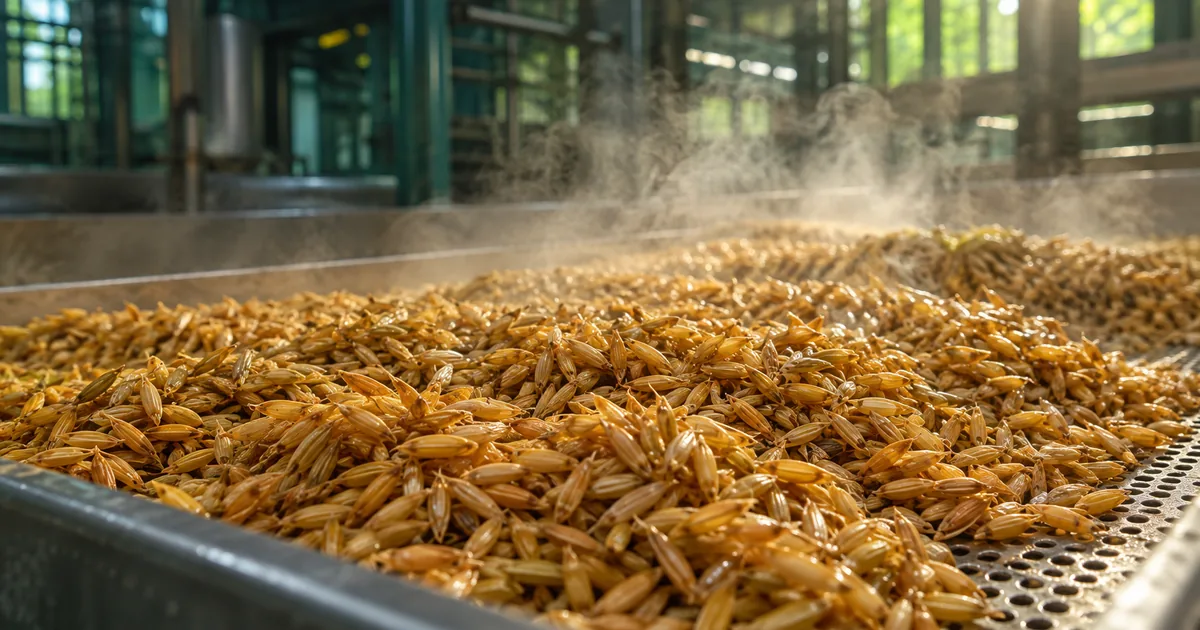
Parboiling of rice means soaking, steaming and drying paddy while it is still in the husk, and only then milling it. The heat gelatinises the starch, so the kernel comes out harder and glassier, small cracks close up, and far fewer grains break in the mill. For a miller, that changes almost every setting downstream: drying, husking, whitening and polishing all behave differently from raw paddy.
Key takeaways
- Three steps, always in this order: soaking, steaming and drying, all done before husking.
- It is the norm in India, not a niche. TNAU puts the share of Indian paddy that is parboiled near 50%, and the Cereals & Grains Association at 55-60%.
- Less breakage is the main pay-off. TNAU reports up to 90% of parboiled grains staying whole, against brokens as high as 50% in raw rice, and a 3-5% gain in total rice yield.
- Drying is where most parboiled rice is lost. Milling before the grain is dried and tempered undoes the benefit.
- Parboiled paddy is harder on equipment. It needs a husking roll built for heat and friction, and more power at the polisher.
This guide walks through the parboiling process step by step, compares the main methods, and then looks at what parboiled paddy does inside your husker and polisher, which is where most guides stop short.
What is parboiling of rice?
Parboiling is a hydrothermal treatment given to paddy before milling: the grain is soaked in water, steamed, and dried, all while the husk is still on (IRRI; TNAU). The product goes by many names: sella, converted rice, easy-cook rice, boiled rice, and miniket in West Bengal, Odisha and Bangladesh (Wikipedia).
It is not a small corner of the trade. Tamil Nadu Agricultural University states that nearly half of the paddy produced in India is parboiled (TNAU), and the Cereals & Grains Association gives 55-60% of India’s rice (Cereals & Grains Association). If you run a mill in eastern or southern India, a large part of the paddy you see has been through this process.
Parboiling process step by step
Every method, from a village kettle to a pressure parboiling plant, follows the same sequence. The figure below shows the flow; the table explains what each step does and where it usually goes wrong.
| Step | What happens | Typical condition | Common mistake |
|---|---|---|---|
| 1. Cleaning and grading | Stones, straw, chaff and empty grains are removed so every grain soaks evenly | Same pre-cleaning as for raw paddy | Mixing varieties or grain sizes, which then soak at different rates |
| 2. Soaking | Paddy absorbs water until the kernel is fully hydrated | Traditional cold soak: 36-38 hours to 30-35% moisture (Wikipedia). Hot soak: roughly 50-70 C for 3-4 hours to about 30% moisture (US patent 4810511) | Getting the soaking time or water temperature wrong: too long or too hot splits husks and, in long cold soaks, encourages fermentation and odour |
| 3. Steaming | Heat gelatinises the starch inside the husk | Atmospheric or pressure steam, from minutes upward depending on the method | Under-steaming leaves white, chalky centres; a fully gelatinised kernel should look translucent (Wikipedia) |
| 4. Drying and tempering | Moisture is brought back down, with rest periods so the inside and outside of the kernel even out | Down to around 14% before milling (IRRI) | Drying too fast in one pass, which cracks the kernel and cancels the benefit |
| 5. Milling | Husking, whitening and polishing, as for raw rice but with different settings | Husker and polisher set for a harder, oilier grain | Running parboiled paddy on raw-rice settings and rolls |
Moisture is the variable that ties the whole process together. For the measurement side, see our guide to paddy moisture content and how to measure it.
Types of parboiling
The methods differ mainly in how the soaking and steaming are done, and that decides time, colour and smell.
| Method | Soaking | Steaming | What it means for the mill |
|---|---|---|---|
| Traditional (cold soak) | Cold water, 36-38 hours | Boiled or steamed until husks begin to split | Low capital, but slow, and long soaks can give an unpleasant smell and mycotoxin risk (TNAU) |
| Hot soak (improved method, such as CFTRI’s) | Hot water, a few hours | Short steaming | About 3 hours instead of 20 (Wikipedia), cleaner smell, yellowish grain that breaks less in milling |
| Pressure parboiling | Hot soak or pre-steaming | Steam under pressure | A further variation on the hot method (Wikipedia), built as dedicated plant |
Whatever the method, the drying stage that follows decides how much of the benefit survives into the bag.
What parboiling changes inside the grain
- The starch sets hard. During steaming the starch gelatinises (gelatinization); as it cools the starch molecules pack tightly again. The kernel becomes harder and looks glassy (IRRI).
- Cracks close up. Small fissures that formed after harvest are mended, which is why head rice recovery rises (IRRI).
- Nutrients move inward. Vitamins, especially thiamine, travel from the bran into the endosperm, so milled parboiled rice keeps more of them than milled raw rice (Wikipedia; TNAU).
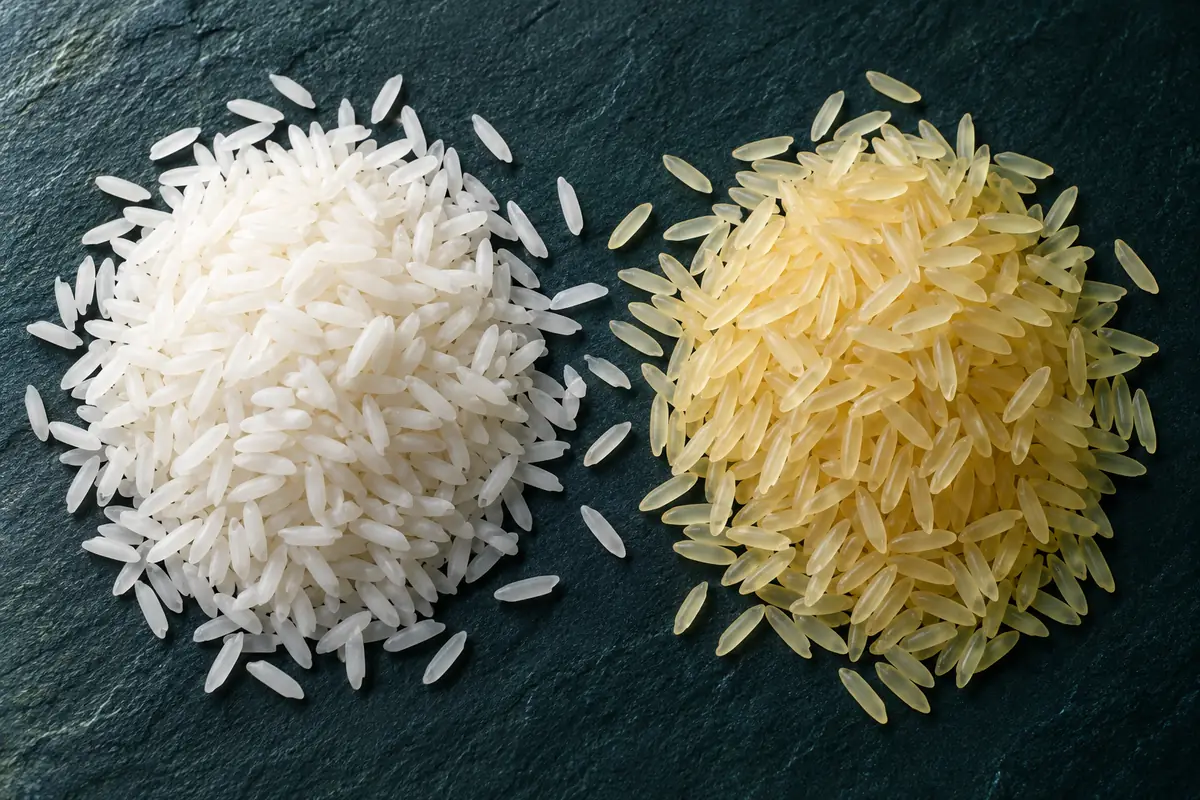
- The colour changes. Bran components give the grain a pale yellow to tan colour, darker than raw rice (Wikipedia).
How parboiled paddy behaves in the rubber roll husker
This is the part most parboiling guides skip, and it is where a mill either keeps or loses the yield gain. A rubber roll husker removes the husk by passing paddy between two rolls turning at different speeds. With parboiled paddy, three things change at the nip:
- The kernel is harder. Roll hardness and clearance set for raw paddy are not right for a parboiled grain.
- The paddy arrives warmer and drier. Freshly dried parboiled paddy can still carry heat into the husker, and the rubber has to hold its shape and hardness at that higher temperature and under the extra friction.
- Wear is faster. More friction per tonne means the roll surface glazes and loses diameter sooner if the compound is not built for it.
That is why parboiling lines use a dedicated roll. Gold Mohur’s parboiled paddy rubber rolls use a heat-resistant compound made for the higher friction and temperature of parboiled dehusking, rated at up to 750 MT of parboiled paddy per pair. For raw paddy, the standard rice rubber roller is the right choice.
Two habits protect head rice on a parboiled line: replace rolls as a pair, and judge a roll by tonnes of paddy cleared rather than by its price. Our rubber roll cost per tonne guide shows how to compare quotes on that basis, and the rubber roller vs steel huller comparison explains why rubber rolls break fewer grains in the first place.
Polishing parboiled rice
Parboiled brown rice is harder work for the polisher. TNAU notes that shelled parboiled rice needs more power to polish, and that its bran, at about 25-30% oil against 10-20% for raw rice bran, can choke the polisher (TNAU).
In practice that means cleaning screens and bran outlets more often, and checking polisher wear parts such as rubber polisher brakes on a shorter cycle than on a raw rice line.
Advantages and trade-offs for the miller
| Advantage | Trade-off |
|---|---|
| Far less breakage: up to 90% of grains stay whole, against brokens as high as 50% in raw rice (TNAU) | Extra capital for soaking, steaming and drying equipment |
| Higher total yield, about 3-5% (TNAU); the official extraction ratio for custom-milled rice is 68% for parboiled and 67% for raw (Government of West Bengal, KMS 2020-21) | More power needed at the polisher, and oily bran that can choke it |
| Bran richer in oil and more stable | Darker colour, and a smell with traditional soaking |
| Harder, smoother grain that insects find difficult to attack | More rancidity in long storage, because heat destroys some natural antioxidants |
| More B-vitamins kept in the milled rice | Mycotoxin risk if soaking runs too long |
All trade-offs in this table are listed by TNAU. On cooking time, sources disagree: IRRI says parboiled rice cooks faster and is firmer and less sticky, while TNAU says it takes longer to reach the same softness. Both agree on the texture: parboiled rice cooks up firm, separate and non-sticky.
Parboiled vs raw milling at a glance
| Raw paddy | Parboiled paddy | |
|---|---|---|
| Grain hardness | Softer, chalky | Harder, glassy |
| Breakage in milling | Higher | Much lower |
| Official extraction ratio (custom milling) | 67% | 68% |
| Bran oil (TNAU) | About 10-20% | About 25-30% |
| Polishing power | Standard | Higher |
| Husking roll | Standard rice rubber roller | Heat-resistant parboiled compound |
| Colour | White | Pale yellow to tan |
Mistakes that break parboiled rice
- Milling straight after drying. Without tempering, the kernel is drier outside than inside and cracks in the husker.
- Drying too fast. A single hot, fast pass fissures the grain the steaming had just healed.
- Uneven soaking. Mixed lots soak at different speeds, leaving some grains under-cooked and chalky.
- Raw-rice rolls and gap settings. A roll compound not made for heat and friction glazes quickly, and a gap set for raw paddy cracks the harder kernel.
- Not checking moisture before milling. Measure it every lot; the figures in our paddy to rice yield guide assume correctly dried paddy.
Parboiling sits at the very start of the line. How the rest of the mill handles the grain after it is covered in our guide to the modern rice milling process.
Running a parboiling line?
Parboiled paddy wears husking rolls faster than raw paddy. Since 1985, Gold Mohur Overseas has supplied husking rolls to rice mills, with a heat-resistant compound made for parboiled paddy.
Frequently asked questions
Is parboiled rice the same as boiled rice?
Yes. “Boiled rice” is the common Indian trade name for parboiled rice. Both mean paddy that was soaked, steamed and dried in the husk before milling. It is also sold as sella, converted rice and miniket.
Why is parboiled rice yellow?
Parboiling moves components of the bran into the kernel, which gives the grain its pale yellow to tan colour. That is why it is sometimes sold as “saffron sella”.
Does parboiling increase rice yield?
Yes. Because far fewer grains break, total rice yield rises by about 3-5% according to TNAU, and the official extraction ratio for custom-milled parboiled rice is 68 kg per 100 kg of paddy, one kilogram more than for raw rice.
How long is paddy soaked for parboiling?
Traditional cold soaking takes 36-38 hours. Hot soaking at roughly 50-70 C brings paddy to about 30% moisture in 3-4 hours.
Which rubber roll is used for parboiled paddy?
A roll made from a heat-resistant compound, because parboiled paddy creates more friction and heat at the husker than raw paddy. Gold Mohur’s parboiled paddy rubber rolls are rated at up to 750 MT of parboiled paddy per pair.
Is parboiled rice healthier than white rice?
It keeps more B-vitamins than milled raw rice, because parboiling moves thiamine and other nutrients from the bran into the grain before milling. Nutritionally it sits closer to brown rice than to polished white rice.
Sources
- IRRI Knowledge Bank: Parboiling (steps, starch, cracks, nutrients, cooking)
- TNAU Agritech Portal, Rice processing (share of Indian paddy, advantages and disadvantages, bran oil, polishing)
- Cereals & Grains Association, Rice: Parboiling (55-60% of India’s rice)
- Wikipedia, Parboiled rice (names, traditional and hot soak timings)
- US patent 4810511, Process for parboiling rice (hot soak 50-70 C, 3-4 hours, 30% moisture)
- Government of West Bengal, rice mill order for KMS 2020-21 (extraction ratio 67% raw, 68% parboiled)