

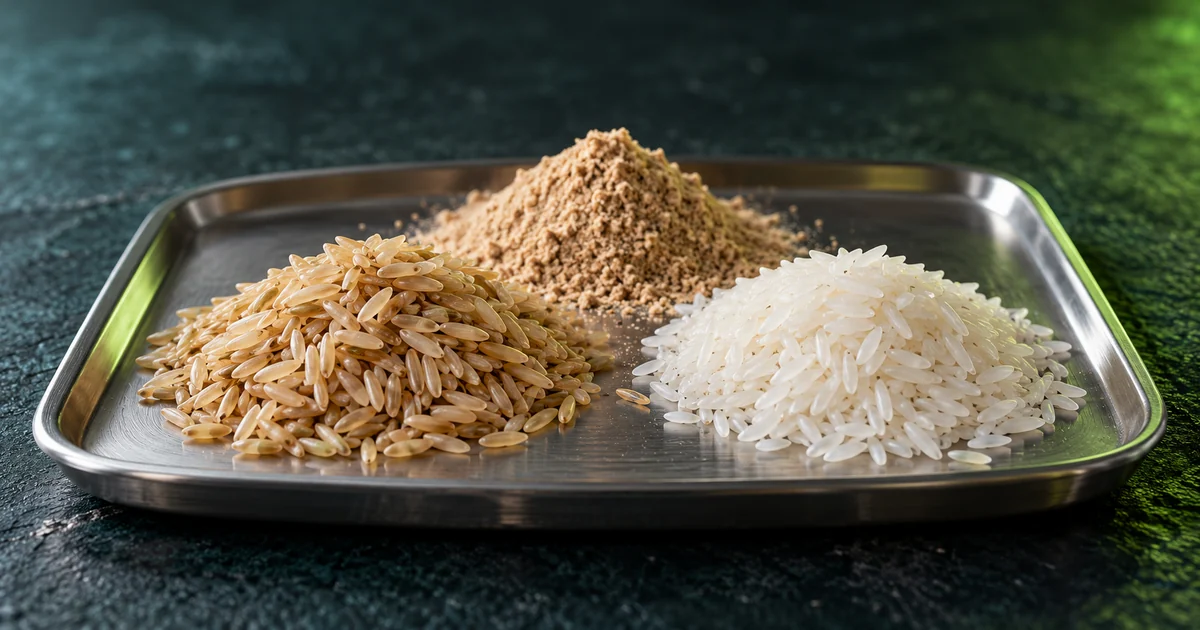
Unpolished rice is the grain as it leaves the husker: the husk is gone, but the bran layers and the germ are still on. Polished rice has been through the whitener and polisher, which strip those layers off and leave only the white starchy endosperm. That one step takes away most of the fibre, oil, B-vitamins and minerals, and in return gives a whiter grain that cooks faster and keeps longer in storage.
Key takeaways
- The difference is made in the mill, not the field. Same paddy, same variety: the husker makes unpolished (brown) rice, and the whitener and polisher turn it into polished rice.
- Most of the B-vitamins sit in the layers that polishing removes. FAO data shows milled rice keeps only about 22% of brown rice’s thiamine, 33% of its niacin and 53% of its riboflavin.
- The fibre and mineral gap is large. Per 100 g raw, USDA lists 3.6 g fibre and 116 mg magnesium for brown rice against 1.3 g and 25 mg for unenriched white rice.
- The glycemic index gap is smaller than most pages claim. The international GI tables list boiled white rice at 73 and boiled brown rice at 68.
- Polishing exists mainly for the market and for storage. The bran carries the grain’s oil, and that oil turns rancid once the husk is off.
Most articles on this topic are written for the person cooking the rice. This one is written from the mill floor: what each machine takes off the grain, what that does to nutrition, cooking and shelf life, and where parboiled rice fits in between.
What polished and unpolished rice mean in a rice mill
A paddy grain has four parts that matter here. On the outside is the husk (hull). Under it is the outer bran layer, made up of the pericarp, the seed coat and the aleurone layer. At one end sits the germ (embryo). Everything else is the endosperm, the starchy white core that most people simply call rice.
Milling takes these parts off in two stages, and each stage gives you a different product:
- Husking removes only the husk. In a modern mill a pair of rubber rolls does this, one running faster than the other, which peel the hull away by shear without cutting into the kernel. What comes out is brown rice, which is what the market calls unpolished rice. You can read how this machine works in our guide to the rice huller.
- Whitening and polishing remove the bran layers and the germ. What comes out is white, polished rice.
So “unpolished” does not mean unprocessed. It means the grain stopped after the husker. “Polished” means it went on through the whitening section of the rice milling process. Between the two sit lightly milled grades, which the trade sells under names such as single polished and double polished, and traditional hand-pounded rice, which loses its husk but keeps much of its bran.
How rice is polished: whitening and polishing
In everyday speech the whole rice polishing process is called polishing, but inside the mill it is usually two jobs:
- Whitening does the heavy work of taking the bran off. Abrasive whiteners use stone wheels that scrape the bran away as the grain passes between the wheel and a screen. Friction whiteners press grains against each other under pressure so that they rub their own bran off; rubber brakes in the machine set how much resistance the grain meets.
- Polishing is the finishing pass. It cleans the remaining bran dust off the surface and gives the grain its shine. Many mills use a water-mist (silky) polisher for this, where a fine spray of water helps lift the last of the bran.
Most mills run several whitening passes rather than one hard pass, and cool the grain and take the bran dust away between them. Each pass removes a little more bran, so the miller sets the polish level by the number of passes and the pressure in each one. The more bran taken off, the whiter the grain, and the more of the grain’s weight goes out with the bran.
The wear parts that do this work are the rice polishing wheels in abrasive whiteners and the rubber polisher brakes in friction whiteners. When either wears unevenly, whiteness drops and broken rice goes up, which we cover in signs it is time to replace your polishing wheels.
What polishing removes: the numbers
The bran and germ are a small part of the grain by weight, but they carry much of its nutritional value: most of the fibre, the oil, and a large share of the vitamins and minerals. The Food and Agriculture Organization of the United Nations gives this split of brown rice’s B-vitamins between the bran, the polish (the inner bran removed in the last passes) and the milled rice (FAO, citing Juliano and Bechtel, 1985):
| Vitamin | In the bran | In the polish | Left in polished (milled) rice |
|---|---|---|---|
| Thiamine (vitamin B1) | 65% | 13% | 22% |
| Niacin (vitamin B3) | 54% | 13% | 33% |
| Riboflavin (vitamin B2) | 39% | 8% | 53% |
Thiamine is hit hardest because it is concentrated in the outer layers and the germ, so polished rice keeps only about a fifth of it.
The second table compares the same type of grain before and after polishing, using the US Department of Agriculture’s standard reference data for raw long-grain rice (USDA FoodData Central, SR Legacy 169703 and 169756). The white rice figures are for unenriched rice, so nothing has been added back.
| Per 100 g, raw | Unpolished (brown) rice | Polished (white) rice, unenriched |
|---|---|---|
| Dietary fibre | 3.6 g | 1.3 g |
| Fat | 3.2 g | 0.66 g |
| Protein | 7.54 g | 7.13 g |
| Thiamine | 0.541 mg | 0.07 mg |
| Niacin | 6.49 mg | 1.6 mg |
| Vitamin B6 | 0.477 mg | 0.164 mg |
| Magnesium | 116 mg | 25 mg |
| Phosphorus | 311 mg | 115 mg |
| Potassium | 250 mg | 115 mg |
| Zinc | 2.13 mg | 1.09 mg |
| Iron | 1.29 mg | 0.8 mg |
In short: polished rice keeps about a third of the fibre content, about a fifth of the magnesium and about one-eighth of the thiamine. Protein changes far less, because most of it sits in the endosperm. FAO’s ranges for brown and milled rice at 14% moisture show the same pattern, with 7.1-8.3 g of protein in brown rice against 6.3-7.1 g in milled rice (FAO).
These are reference samples. Exact values move with variety, growing conditions and how hard the rice is milled, so treat them as a guide to the size of the gap rather than a label for any one batch.
Glycemic index: a smaller gap than most pages claim
Many articles present unpolished rice as low-GI and polished rice as high-GI. The international reference tables are more modest. They list boiled white rice at a GI of 73 (plus or minus 4) and boiled brown rice at 68 (plus or minus 4), and note that most rice varieties are high GI, although some lower-GI cultivars were identified (Atkinson, Foster-Powell and Brand-Miller, Diabetes Care, 2008).
Brown rice does come out lower, and its extra fibre slows digestion somewhat. But the variety of rice and the way it is cooked can matter as much as the degree of polish. Anyone managing their blood sugar levels should take advice from a doctor or dietitian rather than rely on the polish level alone.
Cooking, texture and taste
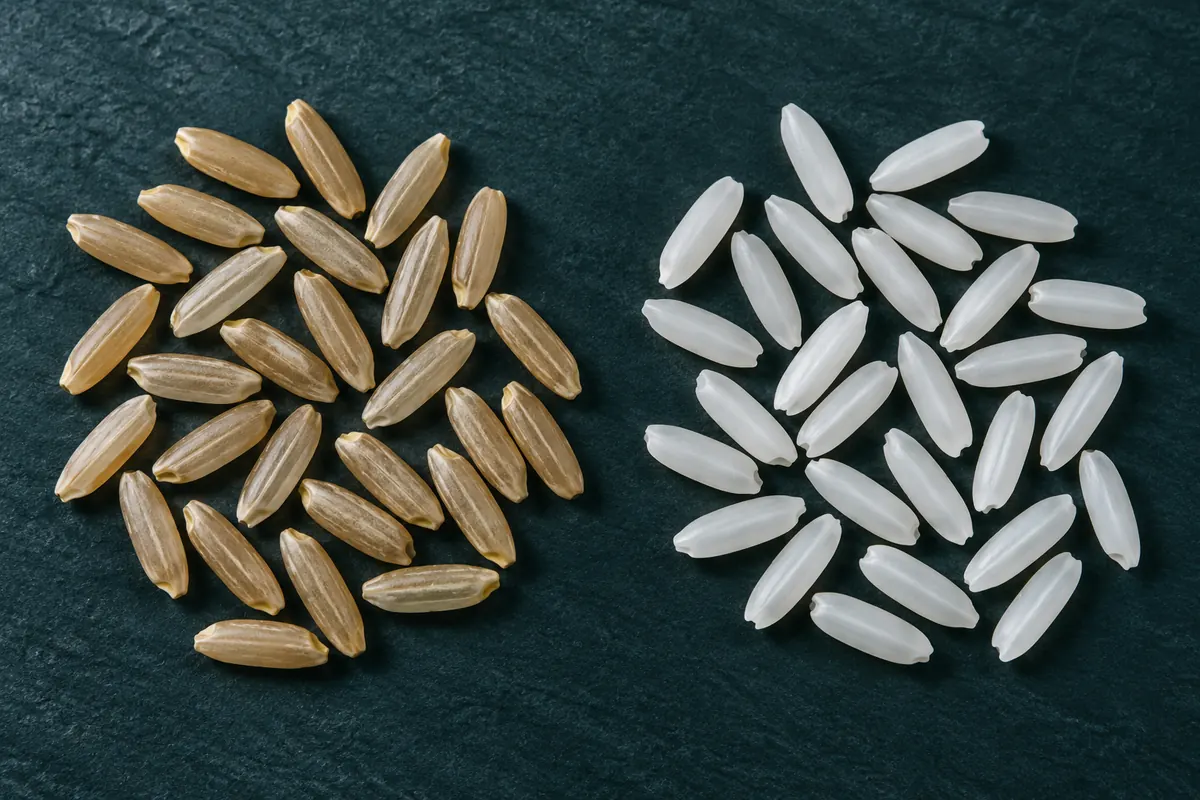
The bran layer is what the cook notices first. Unpolished rice has a longer cooking time and usually needs more water, because water has to get through the bran before it reaches the starch. The cooked grain is firmer and chewier, with a nutty taste and a light brown colour.
Polished rice cooks faster and comes out soft, white and separate, with a mild flavour that suits most everyday dishes. That combination of look, texture and convenience is the main reason white rice dominates the market, and the main reason mills polish.
Shelf life: why mills polish
The other reason is storage. The bran is where the grain keeps its oil. FAO puts crude fat at 15.0-19.7 g per 100 g in rice bran against only 0.3-0.5 g in milled rice (FAO), and the USDA figures above show the same thing: 3.2 g of fat in brown rice against 0.66 g in white.
Once the husk comes off, the bran is exposed and enzymes in it, mainly lipase, start breaking that oil down into free fatty acids. That is what makes brown rice and rice bran turn rancid (review of rice bran stabilisation). Polished rice has had almost all of that oil removed with the bran, which gives it a much longer shelf life in a warehouse, a shop or a kitchen. Unpolished rice is best bought in smaller lots, stored cool and dry in sealed packs, and used sooner.
Parboiled rice: the middle path
Parboiled rice gets around part of the trade-off. Here the paddy goes through water and steam treatment while the hull is still on, and is only milled afterwards. According to IRRI, this treatment shifts micronutrients out of the bran and into the endosperm, so even after whitening the grain is more nutritious than ordinary white rice, and head rice recovery is higher because the steaming closes small cracks in the kernel (IRRI Knowledge Bank).
For the full process and the machine settings it needs, read our article on parboiling of rice. Steamed paddy also wears husking rolls faster than raw paddy, which is why it calls for rubber rolls made for parboiled paddy.
For millers: choosing the degree of polish
For a rice mill, the polish level is a commercial decision as much as a technical one:
- The market sets the target. Most buyers pay for a white, uniform, well-polished grain. Unpolished and lightly polished rice sell to a smaller, health-focused market that accepts a shorter shelf life.
- Every extra pass costs weight. The bran you take off leaves the mill as bran, not as rice, so harder polishing lowers the amount of rice you get from each tonne of paddy. Our guide on how much rice you get from paddy explains how that recovery is measured.
- More pressure means more broken rice. Grains that are already cracked break in the whitener, and broken rice sells for less than head rice.
- Breakage often starts at the husker. Uneven husking leaves a mix of part-husked and over-stressed grains that the whitener then has to work harder on. Keeping the rubber rolls in good condition and correctly set helps the whitener reach the target whiteness with less breakage. We show how to work out the real cost of a roll set in what rubber rolls cost per tonne of paddy.
Difference between polished and unpolished rice at a glance
The table brings the main points together, with parboiled rice alongside for comparison.
| Unpolished (brown) rice | Polished (white) rice | Parboiled rice | |
|---|---|---|---|
| What the mill removes | Husk only | Husk, bran layers and germ | Husk and bran, after soaking and steaming in the husk |
| Fibre, B-vitamins, minerals | Highest | Lowest | More B-vitamins than polished white rice |
| Cooking time | Longest | Shortest | Depends on the parboiling method |
| Texture | Firm, chewy, nutty | Soft, white, mild | Firm, separate grains |
| Shelf life | Shortest (bran oil turns rancid) | Longest | Long once the bran is milled off |
| Typical buyer | Health-focused households | Most households and food service | Large parts of India and Bangladesh |
Which should you choose?
For nutrition, and for the health benefits of extra fibre, unpolished rice is the better choice. For convenience, taste and storage, polished rice wins, which is why it remains the everyday grain. Parboiled rice offers part of both.
Getting the polish right?
Polishing wheels, rubber polisher brakes and husking rolls from Gold Mohur Overseas, made for rice mills since 1985, help you reach the whiteness you want with fewer broken grains.
Polished vs unpolished rice: common questions
Is unpolished rice the same as brown rice?
Yes, in most cases. Both mean rice that has had its husk removed but keeps its bran layers and germ. Red and black rice sold as unpolished are the same idea in coloured varieties.
Why is rice polished?
For appearance, cooking and storage. Polishing gives a white, uniform grain that cooks faster and softer, and removing the oily bran makes the rice keep much longer before it turns rancid.
Does polishing reduce protein in rice?
Only slightly. Most of the protein is in the endosperm. USDA lists 7.54 g of protein per 100 g in raw brown rice and 7.13 g in unenriched white rice. The bigger losses are fibre, B-vitamins and minerals.
Is parboiled rice polished?
Usually, yes. It is husked and whitened like raw paddy. Because the steaming has already pushed micronutrients inward from the bran, polished parboiled rice still holds more of them than ordinary white rice.
Does unpolished rice spoil faster?
Yes. The bran contains oil, and once the husk is off, enzymes in the bran break that oil down and the rice turns rancid. Store unpolished rice cool and dry in sealed packs and use it sooner than white rice.
What is the difference between whitening and polishing rice?
Whitening removes the bran layers from brown rice, using abrasive stone wheels or friction. Polishing is the finishing pass that cleans the remaining bran dust off the surface and gives the grain its shine, often with a fine water mist.
Sources
- FAO, Rice in human nutrition: grain structure, composition and consumers’ criteria for quality (vitamin distribution in bran, polish and milled rice; Tables 14 and 15)
- USDA FoodData Central, SR Legacy (169703 rice, brown, long-grain, raw; 169756 rice, white, long-grain, regular, raw, unenriched)
- Atkinson FS, Foster-Powell K, Brand-Miller JC. International tables of glycemic index and glycemic load values: 2008. Diabetes Care 31(12)
- IRRI Rice Knowledge Bank, Milling and quality (parboiling and micronutrients)
- Non-thermal stabilization strategies for rice bran (review) (lipase and free fatty acids in rice bran)